The success of any restoration project requires time and patience. All such projects are battling flowering plants (angiosperms) that have had a hundred million years to develop strategies for survival. One such strategy involves seed longevity. Seeds that remain viable for five years or more form long-term persistent seed banks.
Longevity experiments have helped determine which seeds remain viable and for about how long. One such experiment was the Michigan State University Beal Seed Experiment: “In the fall of 1879, Professor William James Beal began an experiment to determine ‘the length of time seeds of some of our most common plants would remain dormant in the soil and yet germinate when exposed to favorable conditions.’ This experiment in seed longevity is still active today and has become one of the longest continuously monitored scientific experiments in the world.”
The Beal experiment and other similar experiments give us some idea of the seed longevity of some of our Bluff invasive species. The winner is the common mullein (Verbascum thapsus) with a seed viability of at least one hundred years. Pokeweed (Phytolacca americana) is far behind but still has a viability of at least thirty-nine years.
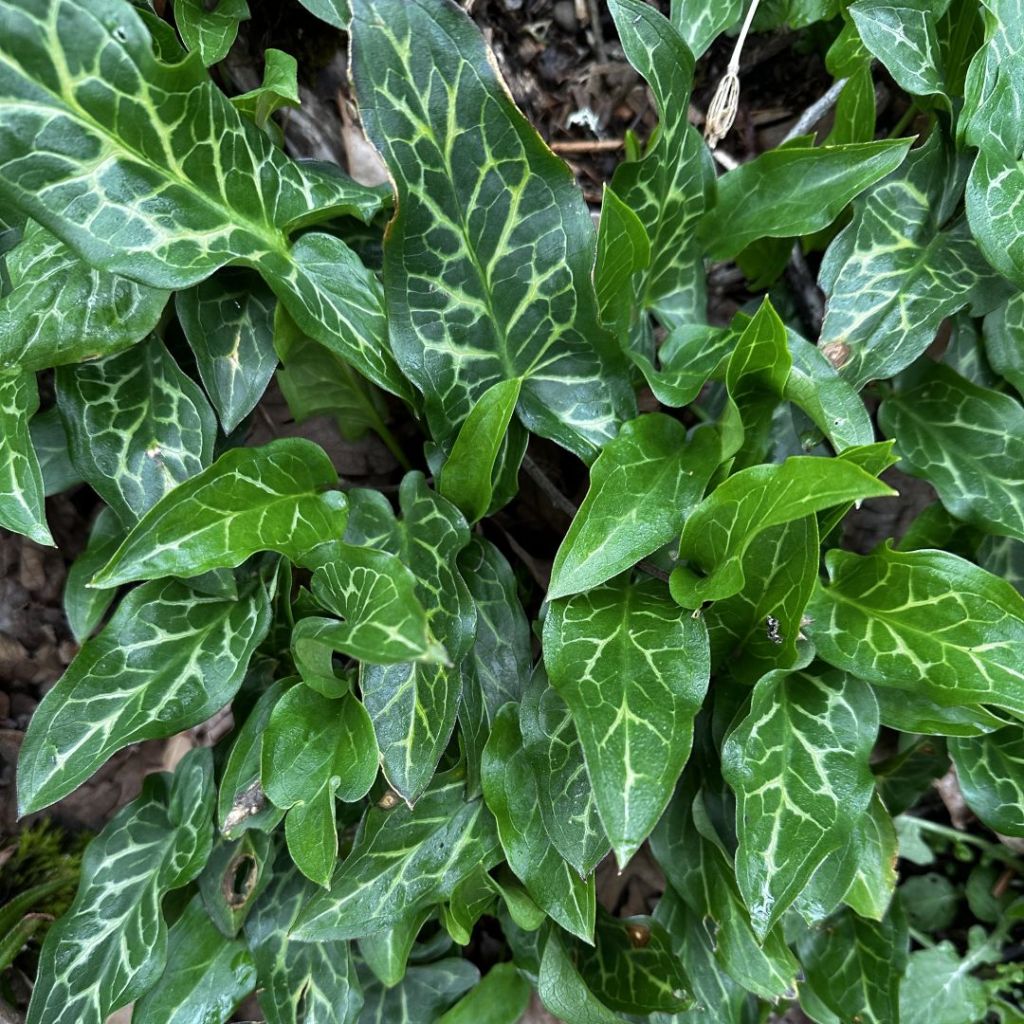
On the Bluff we had a proliferation of poison hemlock (Conium maculatum) and Italian arum (Arum italicum) in the first years following the clearing of Himalayan blackberry thickets. Poison hemlock seeds may remain viable for six years, but it also has another strategy: “Seeds are dispersed over a considerable time period, beginning in July and ending in late February. The extended period during which poison hemlock disperses its seed contributes to its long-term survival in a particular area.”
Italian arum seeds remain viable for over a year. Like poison hemlock Italian arum also relies on multiple strategies. This source explains: “More problematic for management than the species’ seeds are the copious subterranean bulblets produced by mature plants, which remain viable in the soil for many years.” Shining geranium (Geranium lucidum) seeds may remain viable for up to 2 years. Its other strategy is that it may germinate up to five generations in a single growing season.
Though the Rose City Golf Course helped clear the Bluff of Himalayan blackberries around 2001, no doubt a soil seed bank of invasives already existed and more seeds accumulated over the following years. As we have seen, invasive plants also have other strategies for survival. As with all restoration projects RCBR benefits from understanding these strategies and having the patience to counter them.

 Rose City Bluff Restoration