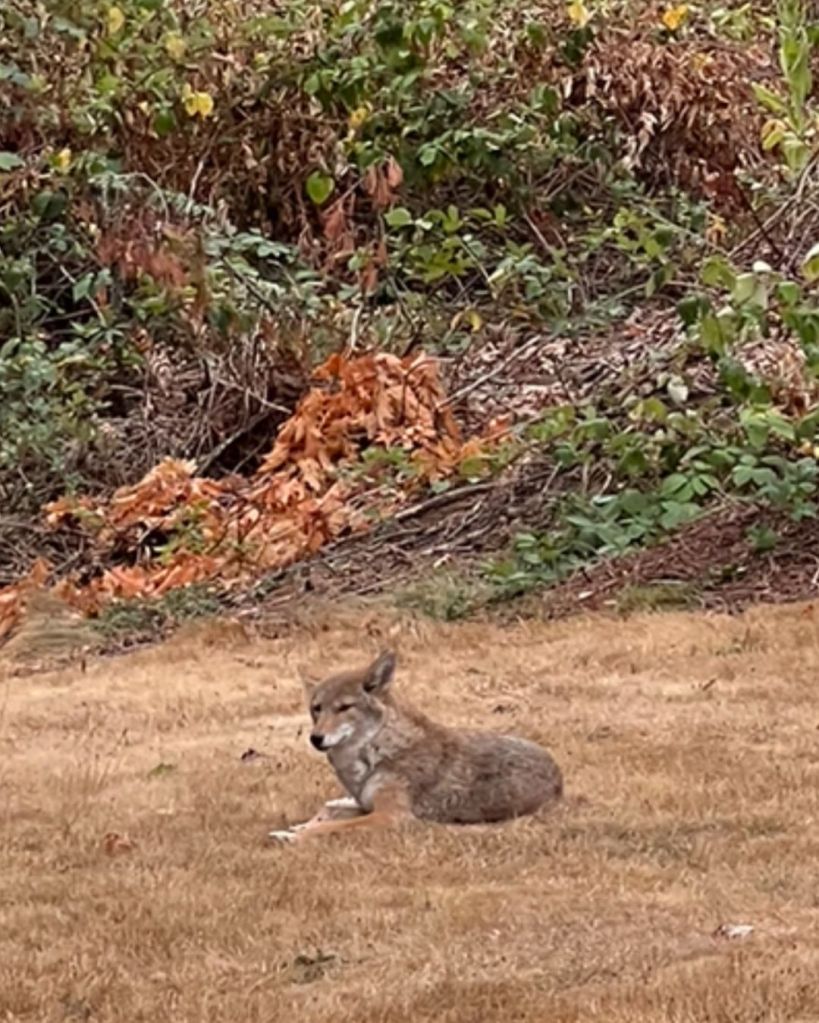
Rose City Bluff Restoration volunteers have been exchanging thoughts and speculation about the habits of our coyotes that live on the Rose City Golf Course. They are such mysterious creatures it’s not surprising that we often wonder what they’re up to but seldom really know. Thanks to our volunteer, Donia Kate, for alerting us to a presentation on urban coyotes last Thursday hosted by the Bird Alliance of Oregon. This answered a lot of our questions about coyote behavior. You can see a version of the same presentation on YouTube here: https://www.youtube.com/watch?v=UZqYFrRpqzA
The presenter, Dr. Stan Gehrt, is principal investigator of the largest and longest study of coyotes in the Chicago area, which has involved the monitoring of over 1600 coyotes over a 25-year period. In this presentation he discussed things learned from these animals living among millions of people, such as how they move across the landscape while avoiding us, how they interact with each other, and how they function as predators in the urban ecosystem. If you are the least bit curious about our urban coyotes, we highly recommend Gehrt’s presentation. Spoiler alert, we even learned that the Chicago coyotes are monogamous. We’re not going to speculate about that regarding the Portland coyotes.
If your curiosity is piqued, we also recommend The Voice of the Coyote, by J. Frank Dobie, first published in 1949. Because it seems particularly relevant to speculation about the behavior of coyotes (particularly the rural variety), we pass along this quote from Dobie’s book:
“The ‘infinite variety’ cultivated by the coyote while adapting himself to changes in environment has probably been characteristic of the species from remotest times. Then as now, the coyote was flexible in hunting habits, killing for himself, accepting refuse from bigger killers; diurnal as well as nocturnal, taking his chance at wood rats out by night, at prairie dogs out only in daylight, at jack rabbits stirring mainly in the evening; sleeping by day on a full belly, hunting by day on an empty belly; in the desert digging for prickly pear roots, on the edge of a swamp slipping up on frogs as skillfully as a coon; no more fixed to one spot of ground, like a wild mare bent on foaling at the same spot annually, than fixed to one habit of eating; careless by nature, careful under necessity.” (Dobie, 1949, p. 39)

 Rose City Bluff Restoration