As the Rose City Bluff Restoration volunteers go about their work each weekend there’s much discussion about plant life on the bluff, both the native and the invasive that we attempt to control. Let’s look at a couple of organisms that don’t get much attention – mosses and lichens. We don’t focus our restoration efforts on mosses or lichens of course, but up close we find them to be every bit as beautiful as many of our native flowering plants. And it turns out that like our plants they can be native, non-native, or even invasive.
We’re used to lumping mosses and lichens together as those things that grow on trees, also known as epiphytes. Wikipedia tells us an epiphyte is a plant or plant-like organism that grows on another plant but is not parasitic. But wait, mosses are plants, but lichens are not and they’re only superficially plant-like. When mosses grow on rocks are they still epiphytes? Thanks to (full disclosure) ChatGPT we confirmed that both mosses and lichens can be epiphytes, but epiphytic is a lifestyle, not a thing. Mosses and lichens are epiphytic if they’re growing on a living plant. When they grow on rocks, they are epilithic. On logs, they’re epixylic.
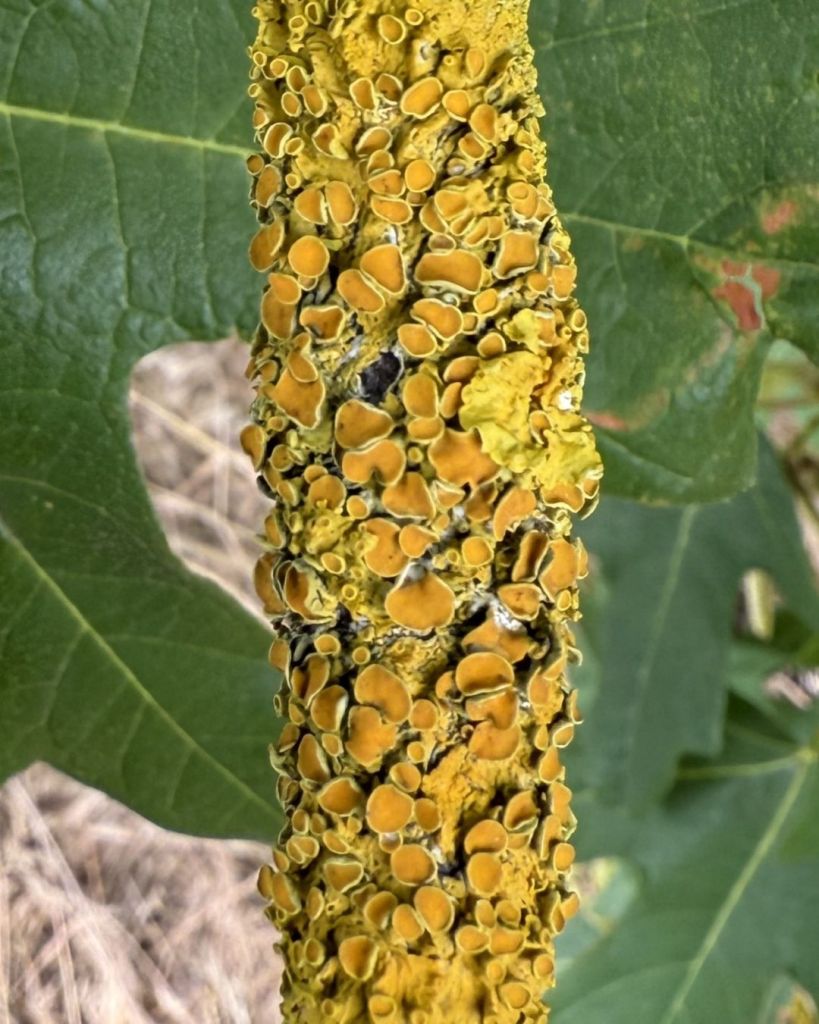
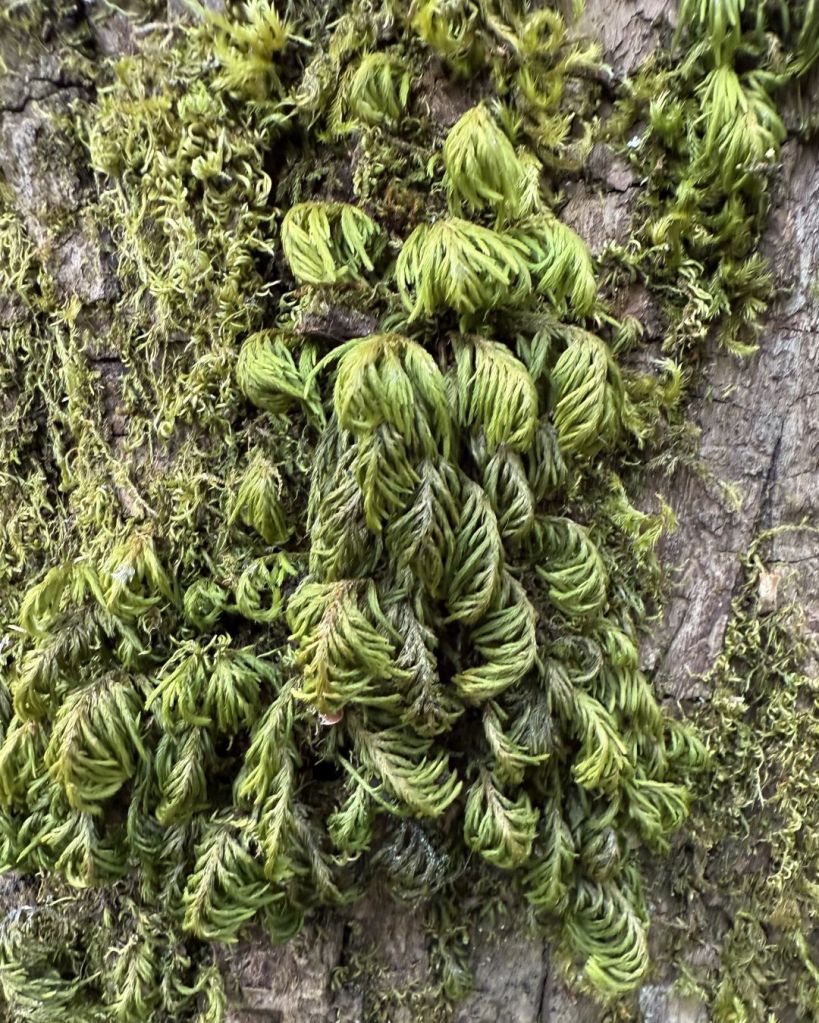
Here are a few other things we learned. Phorophytes are plants (or is it a lifestyle?) on which epiphytes grow. Our bigleaf maples (Acer macrophyllum) along with the vine maples (Acer circinatum) make great phorophytes. The photos below are of the lichen, Xanthoria parietina (common sunburst lichen) and Dendroalsia abietina (Dendroalsia moss). Dendroalsia moss is native to the Pacific Northwest. Common sunburst lichen is not native to our area, but it is also not invasive.

 Rose City Bluff Restoration