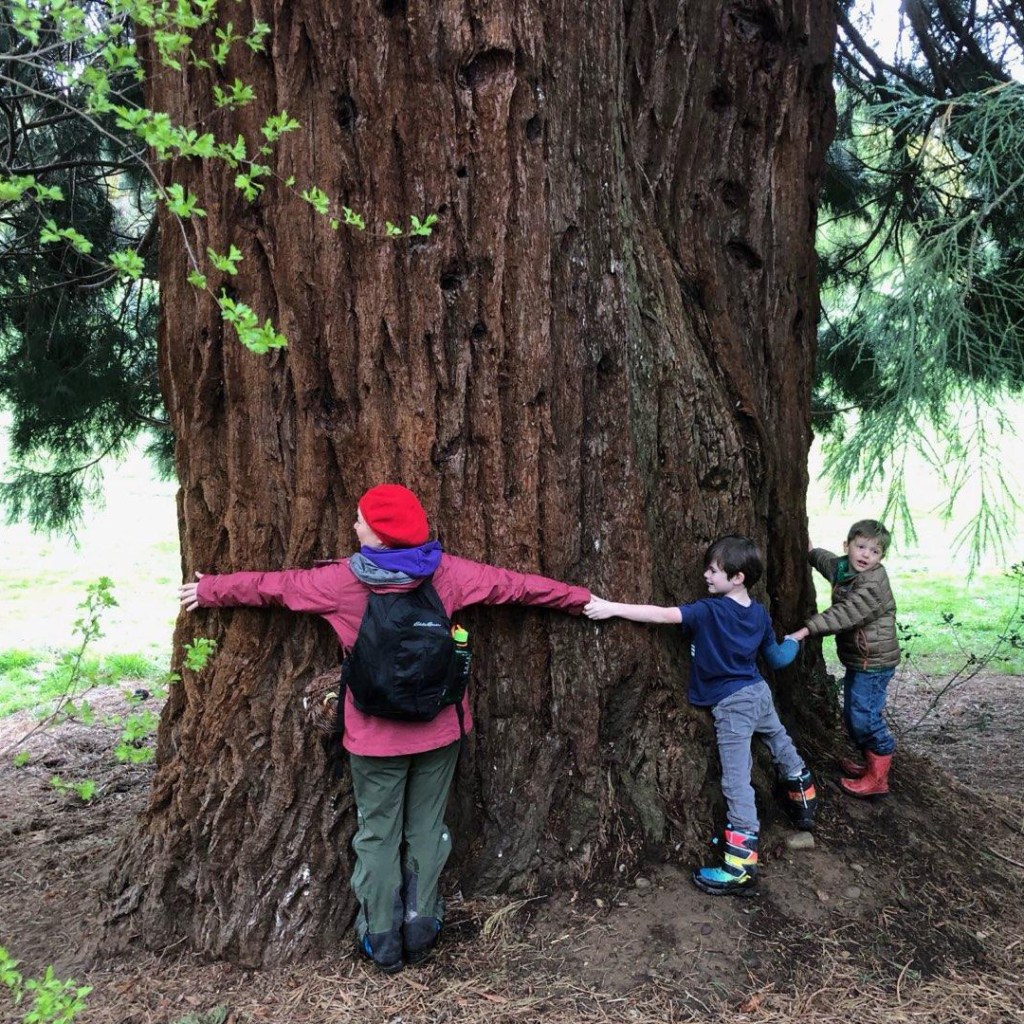
A tour of the Bluff sometimes leads to discussions about its urban biodiversity: the pollinator plants, the habitat, and the exceptionally large trees. Visitors can’t help but notice Northwest natives in the understory and the giant sequoias, the Oregon white oak, Douglas firs, and big leaf maples above.
The giant trees contribute to heat mitigation and air quality, which are mostly local effects. They also play a big part in the broader, non-local effects, particularly carbon sequestration. Being curious about the science behind the contributions of our large trees we came across an article, “Saving Trees Too Big to Hug.” Research by David Mildrexler with contributions from Logan Berner, published in 2020, examined “the proportion of large-diameter trees (21 inches or greater) on National Forest Lands in the Pacific Northwest, and the disproportionally large carbon storage of these trees compared to smaller ones. The research revealed that these large trees store massive amounts of carbon, highlighting their ecological importance in mitigating climate change.
“Although representing only about 3 percent of all trees in the study area, these large trees accounted for about 42 percent of the above-ground carbon storage in the forests, making them significant in the context of a warming climate by keeping that carbon out of the atmosphere.”
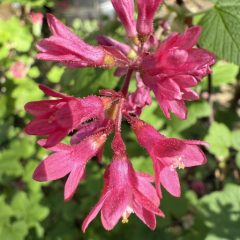
Bluff visitors are also apt to notice the variety of Northwest native understory plants that grow below the tree canopy: Oregon grape, snowberry, ocean spray, and red flowering currant. Most of the mature Northwest natives came from an effort undertaken around 2001 when the late Jim Heck, the Rose City Golf Course superintendent, and the city partnered with neighborhood volunteers to replace invasive plants on the Bluff with Northwest natives. Many of those plants survived the overwhelming spread of blackberry thickets that followed. As a place to connect with nature, the Bluff benefits hugely from these mature Northwest native understory plants and the sheltering large trees above.
It turns out that the lead author of the paper describing the study of large trees, David Mildrexler, grew up in the Rose City Park neighborhood and was a volunteer on the 2001 Bluff restoration project! David now resides in Eastern Oregon where he is the Systems Ecologist at Wallowology, the public education and outreach division of Eastern Oregon Legacy Lands, whose mission is to expand land conservation in Eastern Oregon through public education, landscape-level planning, and land acquisition. We recently contacted David, and he would like everyone to know how happy he is that volunteers are restoring the Bluff and building community in his old hood.
Read more about the science behind “trees too big to hug” here:
“Protect large trees for climate mitigation, biodiversity, and forest resilience”
https://conbio.onlinelibrary.wiley.com/doi/full/10.1111/csp2.12944
and here:
“Large Trees Dominate Carbon Storage in Forests East of the Cascade Crest in the United States Pacific Northwest”

 Rose City Bluff Restoration