Moss grows all over Portland, thriving in the Pacific Northwest’s moist, shady conditions. Different mosses can have a global reach, be native to a region, or even be invasive. Oregon beaked moss (Kindbergia oregana) and cat’s tail moss (Isothecium stoloniferum) are common in the Portland area. While mosses in general are not listed on the Portland Plant List, there is an important ecological consideration regarding the trade and harvesting of certain mosses that grow in the Pacific Northwest. This practice has raised concerns about its potential ecological impact and the possibility of spreading invasive species.
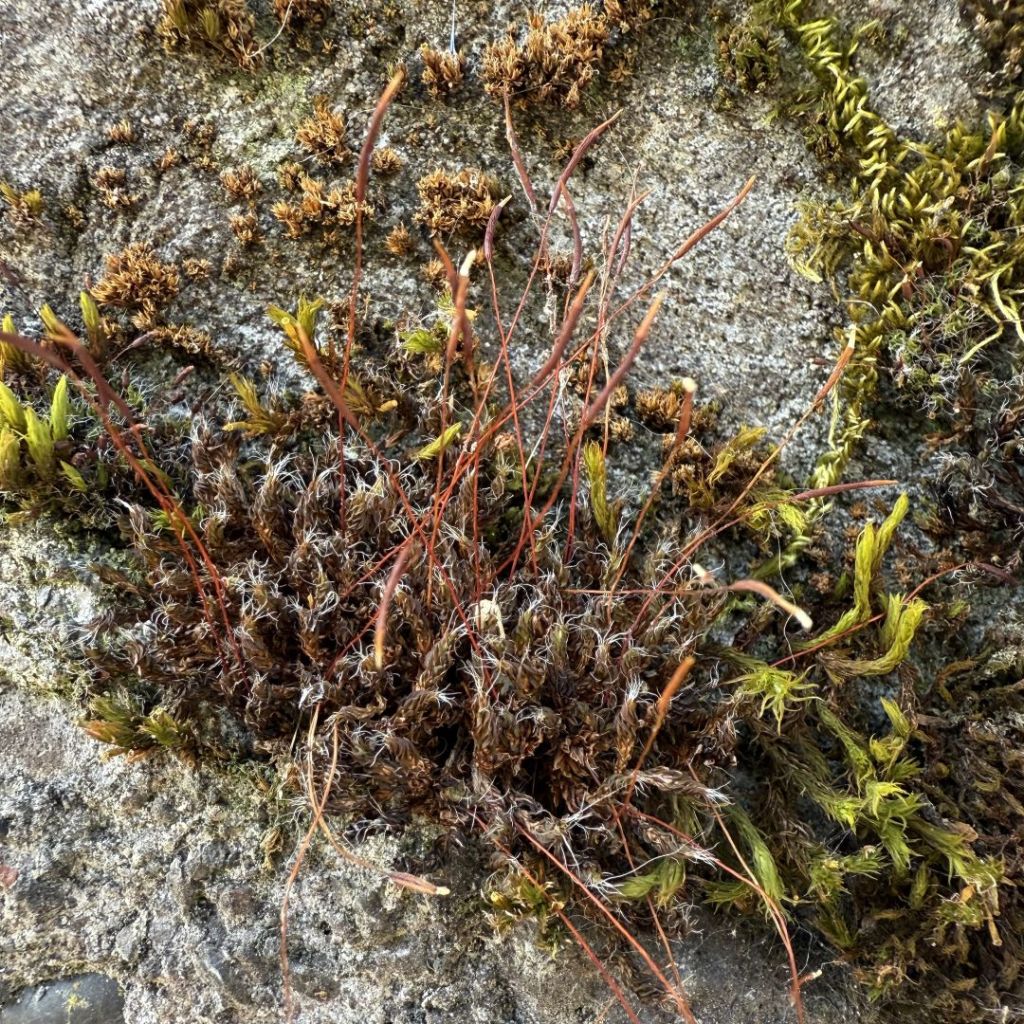
One of the most interesting things about moss, other than being a primitive non-vascular and flowerless plant, is that in its primary form (the green stuff we usually see) the cells are haploid – they contain a single set of chromosomes. The life cycles of primitive plants like moss and fungi are predominantly haploid. In more recently evolved plants like flowers, the emphasis shifts to the diploid. In a moss, the diploid stage is the sporophyte, including the thin stalk-like structure (see photo). The sporophyte is short-lived but produces spores. When these spores germinate, they grow into leafy green moss, starting the cycle over again.
Why should we care about moss? A recent study published in Nature Geoscience suggests that moss might also be important to climate change mitigation. Ecologists David Eldridge and Manuel Delgado-Baquerizo uncovered evidence that moss has the potential to store a massive amount of carbon in the soil. In fact, mosses sequester around 6.43 billion metric tons more carbon in the soil than is stored in the bare patches of soil without any plants typically found nearby them in global semi-arid areas. This is six times the annual worldwide global carbon emissions caused by deforestation, urbanization, and mining. While moss contributes to carbon sequestration it is also a soil stabilizer, a water retainer, and a habitat for small creatures. It is among the first plants to colonize disturbed areas.
Respyre, the Netherlands company, has come up with a technology to create moss walls and incorporate them into architecture more easily. First, they add a layer of porous concrete cladding to a wall. Then they apply a bio-gel that contains moss spores and the nutrients they need. This fast-tracks the natural processes that lead mosses to grow on walls.
You can create your own moss wall with a moss milkshake. This involves putting moss into a blender with buttermilk, yogurt, beer or potato water and enough water to make a thick consistency. Blend the mixture until it is like a thick milkshake or smoothie. Use a paint brush to apply to rocks, walls, or soil. Warning: this could be a tricky and messy process.
Want to know more? Here is a helpful podcast all about moss, and the ecosystem that lives in that tiny, fluffy world. Crisscrossing Science (Michael Crosser & Chad Tillberg, professors at Linfield University).

 Rose City Bluff Restoration