This week we’re looking at community-driven projects in our neighborhood – in particular the Roseway Parkway Plaza, the Bird’s Eye Café, and the Rocky Butte Farmers Market – and how they have created great social gathering spots from small urban spaces. We were inspired to think about these people-friendly spaces by William H. Whyte’s 1980 movie, The Social Life of Small Urban Spaces. (Watch on Youtube.) Whyte started a revolution in urban planning and design when he published a book with the same name. His pioneering study of pedestrian behavior and city dynamics showed that social life in public spaces contributes fundamentally to the quality of life of individuals and society as a whole. Whyte believed that we have a moral responsibility to create physical places that facilitate civic engagement and community interaction.
Whyte subsequently shaped the work of some of today’s leading urban planners. The Project for Public Spaces founder and president, Fred Kent, worked as Whyte’s research assistant on the Street Life Project, conducting observations of corporate plazas, urban streets, parks, and other spaces in New York. Kent based PPS largely on Whyte’s methods and findings.
Whyte also influenced Jan Gehl, the Danish architect and urban design consultant whose career has focused on improving the quality of urban life by re-orienting city design towards the pedestrian and cyclist.
Jane Jacobs was an urban activist and author known for her influential book, The Death and Life of Great American Cities, which critiqued top-down urban planning and promoted community-centered development. When William H. Whyte was an editor at Fortune magazine, he invited Jacobs to author the article, “Downtown is for People” (1958), that launched her career and provided a platform for her groundbreaking ideas.
Though Whyte focused initially on major public and corporate spaces, his influence is now felt on community-driven urban spaces as well. The Bird’s Eye Café is a perfect example of Whyte’s observation in praise of small spaces: “The multiplier effect is tremendous. It is not just the number of people using them, but the larger number who pass by and enjoy them vicariously, or even the larger number who feel better about the city center for knowledge of them.” (William H. Whyte, emphasis ours.)
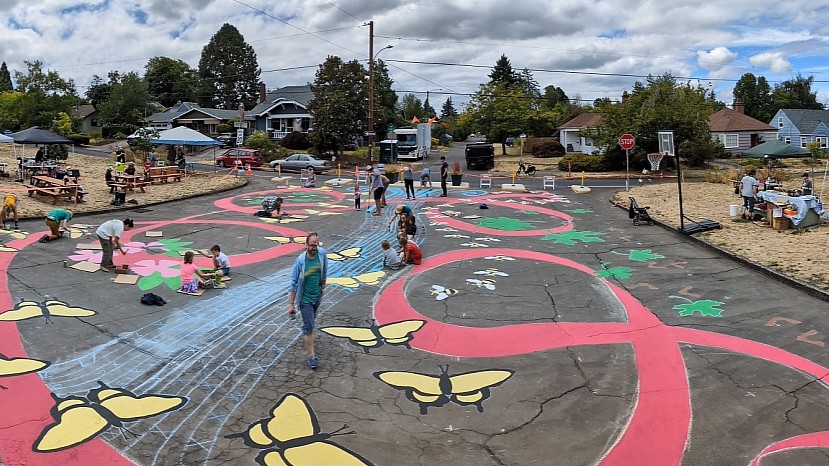
“The more successfully a city mingles everyday diversity of uses and users in its everyday streets, the more successfully, casually (and economically) its people thereby enliven and support well-located parks that can thus give back grace and delight to their neighborhoods instead of vacuity.” (Jane Jacobs, emphasis ours.) The Roseway Parkway Plaza, NE 72nd and Mason Street Plaza, once just an everyday street, is now a great place to facilitate civic engagement and community interaction.
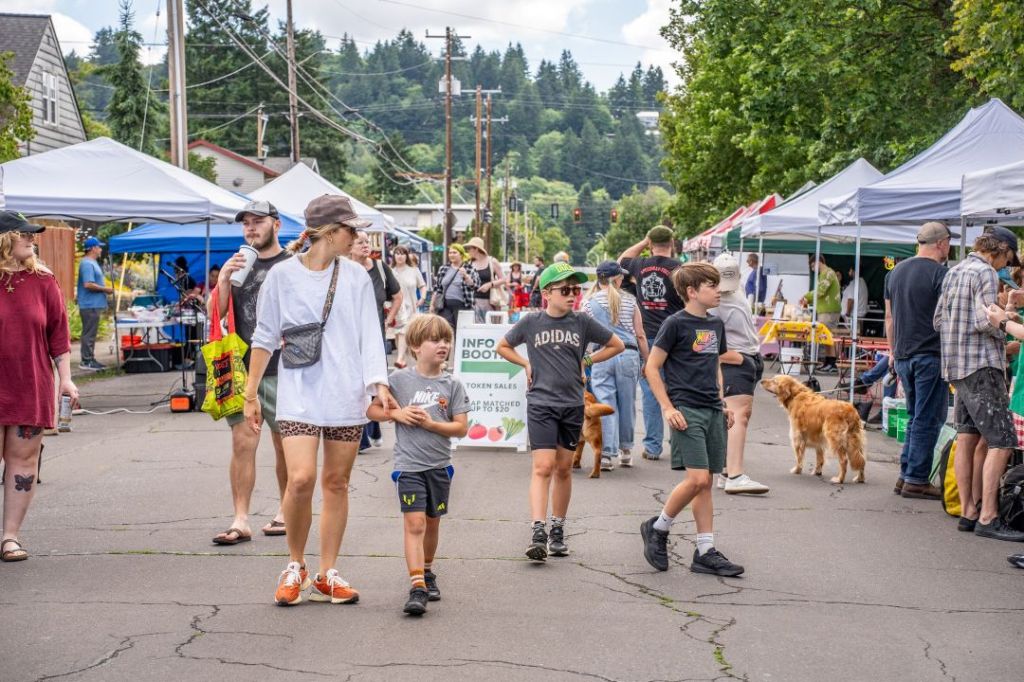
The Rocky Butte Farmer’s Market is our favorite place to spend a Saturday morning. We love how in its new location it transforms an otherwise mundane street into a market promenade. According to Jan Gehl, a key is to show people what their lives in the city could be like. “A good city is like a good party — people stay longer than really necessary because they are enjoying themselves.” (Jan Gehl, emphasis ours.)
“Cities have the capability of providing something for everybody, only because, and only when, they are created by everybody.” (Jane Jacobs)

 Rose City Bluff Restoration