
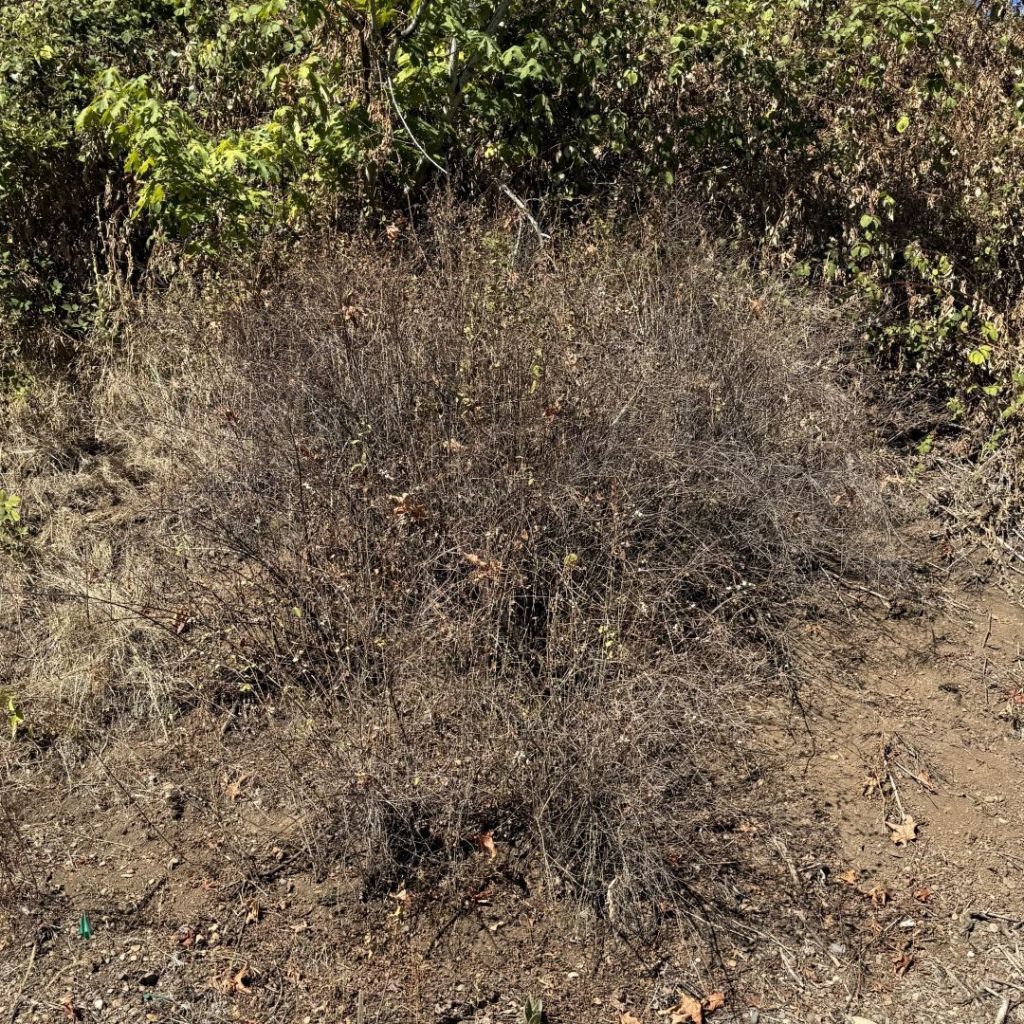
This is another in our series of posts about using technology to improve climate resilience. Each year around this time, one of the Bluff’s large snowberry bushes dries out, loses its leaves, and appears almost dead. Other shaded snowberry bushes remain green and healthy looking. The native snowberry (Symphoricarpos albus) grows well in sun or shade, wet or dry conditions. However, the southern facing Bluff slope, especially areas in full sun, can be difficult for plants during dry spells. When considering native plants to add to the Bluff we are increasingly aware of the potential for climate change to make things ever more challenging. Large, mature trees shade much of the Bluff, and in those areas, we expect native plants to do well. Where we must be especially careful what we plant is in our sunny southern-exposed areas.
We see our southern-exposed snowberry bush as a metaphor for climate challenged communities. In 2021, a heat dome occurred over Portland, resulting in multiple fatalities and drawing attention to the vulnerability of specific population groups. Despite the heat dome being an anomaly, Portland faced another severe heat wave in August 2023 with temperatures over 100°F, leading to multiple heat-related fatalities.
Urban heat distribution is uneven. On July 22, 2023, 125 volunteers mapped differences in temperature throughout the Portland Metro region. The area counties partnered with a Portland company, CAPA Strategies, in a groundbreaking heat mapping project that measured the unequal distribution of heat in our communities. Using special equipment, volunteers collected more than 269,000 temperature readings in neighborhoods across the area. The Portland metro project covered over four hundred square miles. Lents, Mall 205, and industrial areas near Portland International Airport were among the hottest areas. These areas have fewer trees, more roads, rooftops, parking lots, and sprawling development. The coolest areas are parks and rural forested areas.
The heat mapping technology that CAPA Strategies developed now supports communities in addressing climate change across the United States and internationally. CAPA’s team of researchers, planners, and data scientists helps cities assess hazards and identify adaptation strategies for the future. Developed in Portland, CAPA’s Heat Watch technology helps communities map and mitigate urban heat islands.
Rose City Bluff Restoration volunteers encourage you to support efforts to improve climate resilience in all our area communities.

 Rose City Bluff Restoration