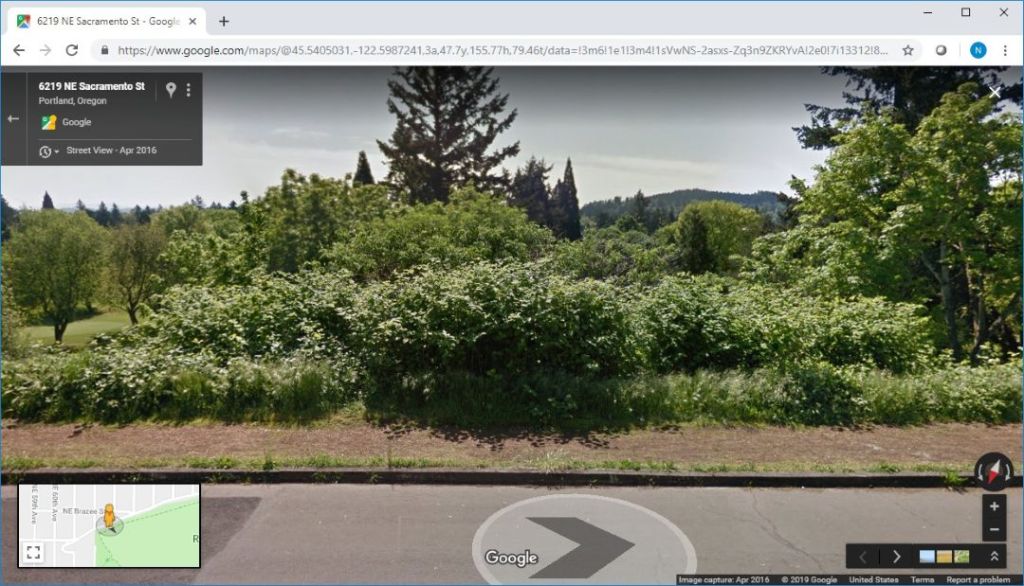
Although the City of Portland does not include Japanese knotweed (Reynoutria japonica) on its Required Eradication List, Portland is nevertheless concerned about its spread because it is so extraordinarily difficult to eradicate. Knotweed is spread primarily by fragments, especially of roots and stem nodes. Frequent cutting helps but requires that every fragment be removed and disposed of. Digging is not recommended since it can regrow from small fragments. Under the right circumstances, licensed professionals may apply glyphosate-based herbicides, but this is not an option for our volunteers. A Rose City Bluff Restoration volunteer has been tackling our single patch of knotweed without using chemicals for seven years.
Knotweed is native to Japan and other parts of Asia where it is not a nuisance because it has natural predators and grows in a highly competitive ecosystem. A range of native soil fungi and plant diseases attack various parts of the knotweed plant, suppressing its spread. Grass like bamboo limits knotweed’s ability to form dense monocultures seen elsewhere. Over 186 species of insects feed on knotweed.

For example, the sap-sucking insect, Aphalara itadori (Japanese knotweed psyllid), feeds only on knotweed and damages the leaves and stems. This highly specific insect co-evolved with knotweed, making it a promising, long-term solution to reduce the invasive plant’s dominance. Aphalara itadori has been deliberately released in the UK and North America (including Oregon and Washington) as a biological control agent to manage knotweed without harming native flora.
When RCBR began working on the Bluff, the Himalayan blackberry (Rubus armeniacus) was so widespread that the patch of knotweed was not everyone’s first concern. Perhaps it should have been. Blackberry spreads fast, but knotweed spreads even faster (especially along waterways). Blackberry is hard to eradicate, but doable. Knotweed is extremely difficult to eradicate. In some localities there can be financial and legal risks for failing to manage Japanese knotweed. In the UK, British Columbia, and parts of the US (MA, OH, MI, MN) there can be risks concerning property devaluation, mortgage issues, costly eradication, and legal liability for spread to neighbors, with the UK having strict disclosure laws and fines for misrepresentation. Many areas of the US have general “duty to disclose defects” laws, meaning you could still be liable if you hide a known problem that affects the property’s value, even without specific knotweed laws.
Since herbicide is not an option for RCBR, careful repeated cutting is the only option for the Bluff. It is possible to eradicate knotweed without chemicals, but it is a long, labor-intensive process requiring extreme persistence, focusing on repeatedly cutting stems to starve the roots or covering large areas to block sunlight. Thankfully, Neil accepted the job of eradicating our patch of knotweed. Seven years later, the knotweed persists, but each spring less of it comes back.
We will leave you with these thoughts: Blackberry is a nuisance, but knotweed is a nightmare. Blackberry is aggressive, but knotweed is relentless. Blackberry is hard to remove, but knotweed is almost impossible. Blackberry takes over land, but knotweed takes over everything.

 Rose City Bluff Restoration