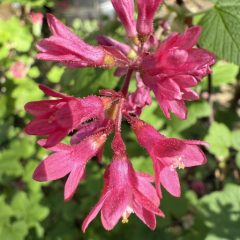
We recently came across some new-to-us terminology for and concepts about plant strategies to ensure the continuation of their species. Dichogamy and herkogamy, for example, are key plant adaptations that prevent self-pollination (inbreeding) and promote outcrossing (outbreeding). Dichogamy is separation in time of male pollen dispersal and female pollen reception functions in a flower. Herkogamy is the spatial separation of male-female reproductive parts. Understanding these strategies helps us understand how native plants survive in restoration projects.
Several native Pacific Northwest plants exhibit dichogamy, including species of maple like vine maple (Acer circinatum) and bigleaf maple (Acer macrophyllum). The red-flowering currant (Ribes sanguineum) is protogynous, meaning the female reproductive parts are receptive to pollen before the male parts are ready to release pollen. Oregon grape (Mahonia aquifolium) flowers are often protogynous. Western columbine (Aquilegia formosa) also exhibits protandry.
Delving into how this becomes relevant to restoration on the Bluff, we quickly realized that we might be in over our heads. Certainly, we are curious about what increases or impedes the success of native plants we add to the Bluff. However, the science behind native plant propagation, restoration, and conservation is complex. Some of the terminology only applies to projects much larger than our own. Relatively small urban restoration projects like the Bluff, or even backyard habitats, isolate areas of native plants such that they respond differently than they would in much larger areas. So, rather than suggest this post is about Bluff restoration, we want to emphasize that we’re pulling from sources and concepts that apply to the broader field of native plant restoration.
Outcrossing, allogamy, and xenogamy are terms that describe how plants cross-pollinate. The advantage of outcrossing versus selfing is that over generations it introduces new unrelated genetic material to increase diversity and reduce harmful recessive traits. A small, isolated restoration site may include plants that exhibit dichogamy but have few opportunities to be exposed to pollen with different genetic material.
Inbreeding depression in native plants occurs when closely related individuals cross-pollinate, reducing genetic diversity, leading to lower survival due to the expression of harmful recessive traits, and affecting everything from germination to defense against enemies. It can be a critical factor in conservation biology for small, isolated populations.
Domestication in plants describes the selection of source plants with desirable traits that may make them easier to grow (like holding onto seeds) rather than traits needed for survival in nature (like dispersing seeds effectively). The ability to produce large amounts of source seed is good for large restoration projects but may lower genetic variability, potentially making the plants less able to adapt to a changing environment. Domestication transforms plants for human benefit, creating distinct varieties from wild ancestors, but it can negatively impact the long-term viability of plant populations.
Ecotypic variations are the genetic differences found in large geographic populations of a single species, adapting them to distinct environmental conditions. This variation in survival traits arises from natural selection acting on different environments, creating genetically distinct, locally adapted populations. Ecotypic variation is the evolutionary response to local conditions including climate, soil, or altitude. Ecotypic variations can impact restoration projects because locally adapted ecotypes may perform better under specific environmental conditions. Using non-local sources that are not adapted to the specific restoration site can reduce fitness and survival rates.
Rose City Bluff Restoration is currently in the process of sourcing plants for next fall’s planting. None of the above considerations specifically concern small restoration projects like ours. The factors that increase or impede our success rates are basic – adequate rainfall, foraging rabbits, competition from invasive species. Factors under our control are simply how well we prepare and protect our native plants. Beyond that we do strongly encourage our neighbors to help us create a wider restoration project by planting natives in their own yards.


 Rose City Bluff Restoration
Wow! Yes, working on promoting two native gardens near the Bluff and south of the golf course- mine and my mother’s. Thanks for this post!
LikeLike