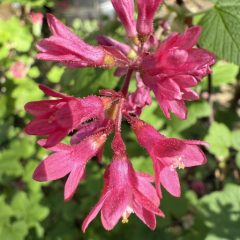
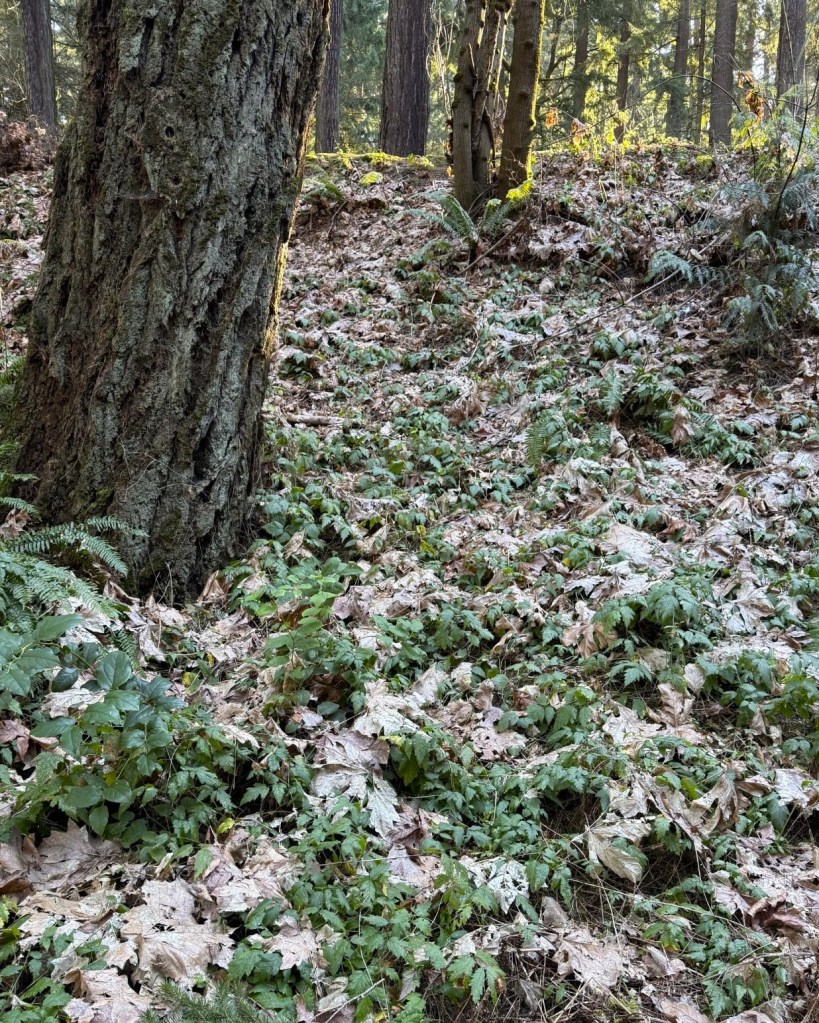
Between 2002 and 2018, the Rose City Bluff remained largely undisturbed, allowing humus to accumulate beneath the blackberry thickets. The Bluff is steep, rocky, full of blackberry roots, and has a persistent seed bank of invasive plants. Nevertheless, we think the soil quality throughout the Bluff is generally favorable. We’ll speculate that it has to do with humus.
According to Wikipedia: “It is difficult to define humus precisely because it is a very complex substance which is still not fully understood . . . Fully formed humus is essentially a collection of very large and complex molecules formed in part from lignin and other polyphenolic molecules of the original plant material (foliage, wood, bark), in part from similar molecules that have been produced by microbes. During decomposition processes these polyphenols are modified chemically so that they are able to join up with one another to form very large molecules.”
“Airy Humus” by Lynn Tudor Deming
So it goes on a good afternoon, screening
this top soil by the drive, jostling it
over the mesh so the clean loam drops
through, sifting out delicate cobwebs of roots,
tendrils of weeds limp in slime, my sweat salting
the collards of this stew until everything unwanted—
little green bowls of splintered pignut, broken
twigs, earth-caked stone, is left behind;
better still to sift the head’s glut—
its sticky detritus—reaching at last the airy
humus, so the tune of the wind blows fresh
into the dull mind, its chaff scattering,
the way a breeze moves over marsh grass,
and winnows it, in the haze of far-flung deltas.
Lynn Tudor Deming’s “Airy Humus” is featured by A Room of Her Own Foundation (AROHO): https://aroomofherownfoundation.org/airy-humus-by-lynn-tudor-deming/

 Rose City Bluff Restoration