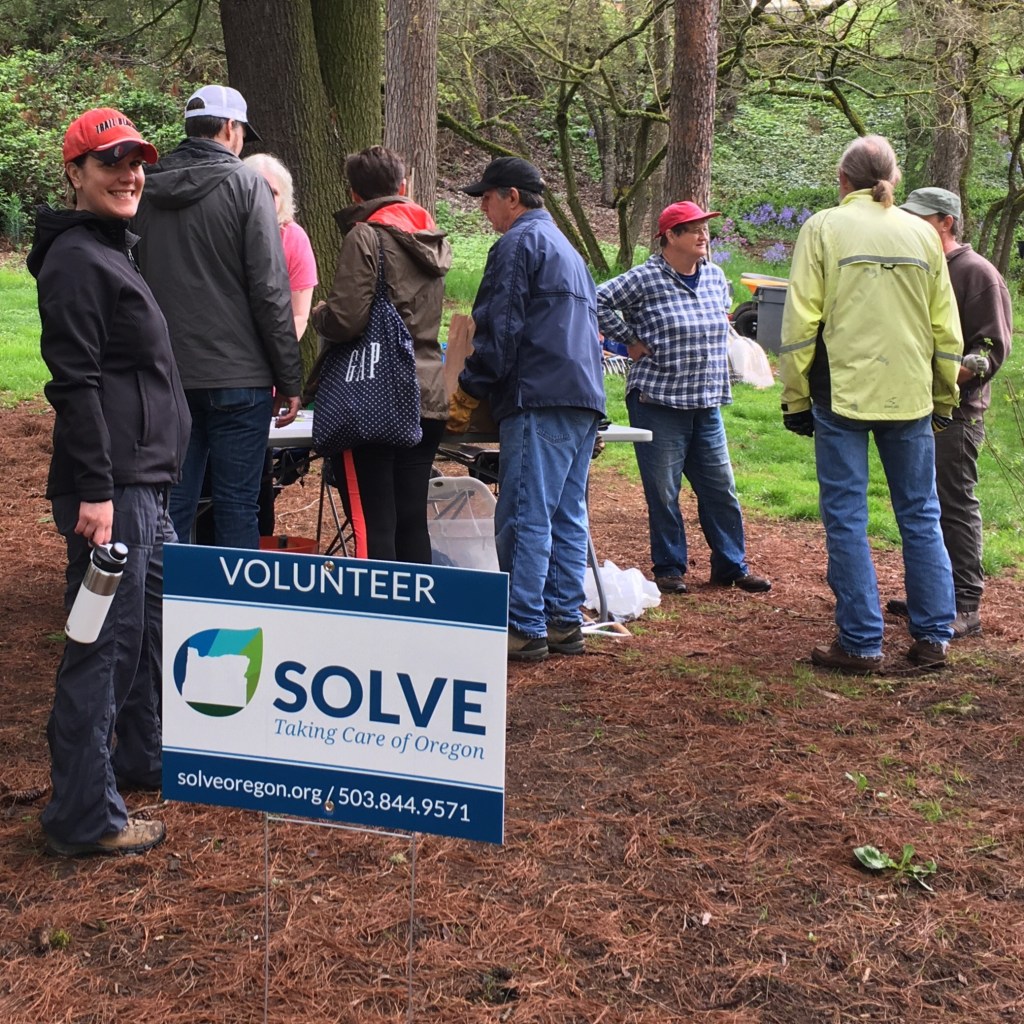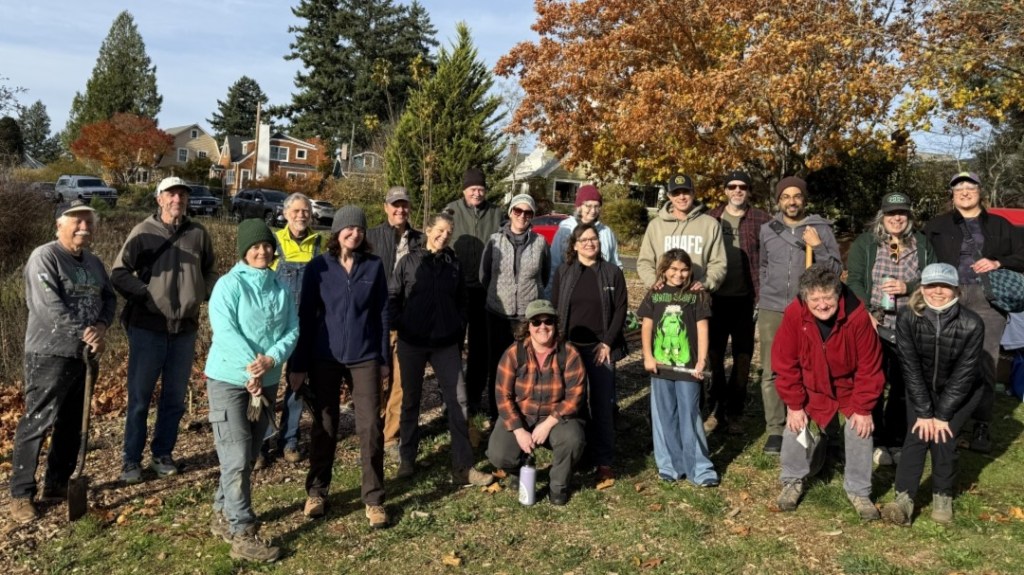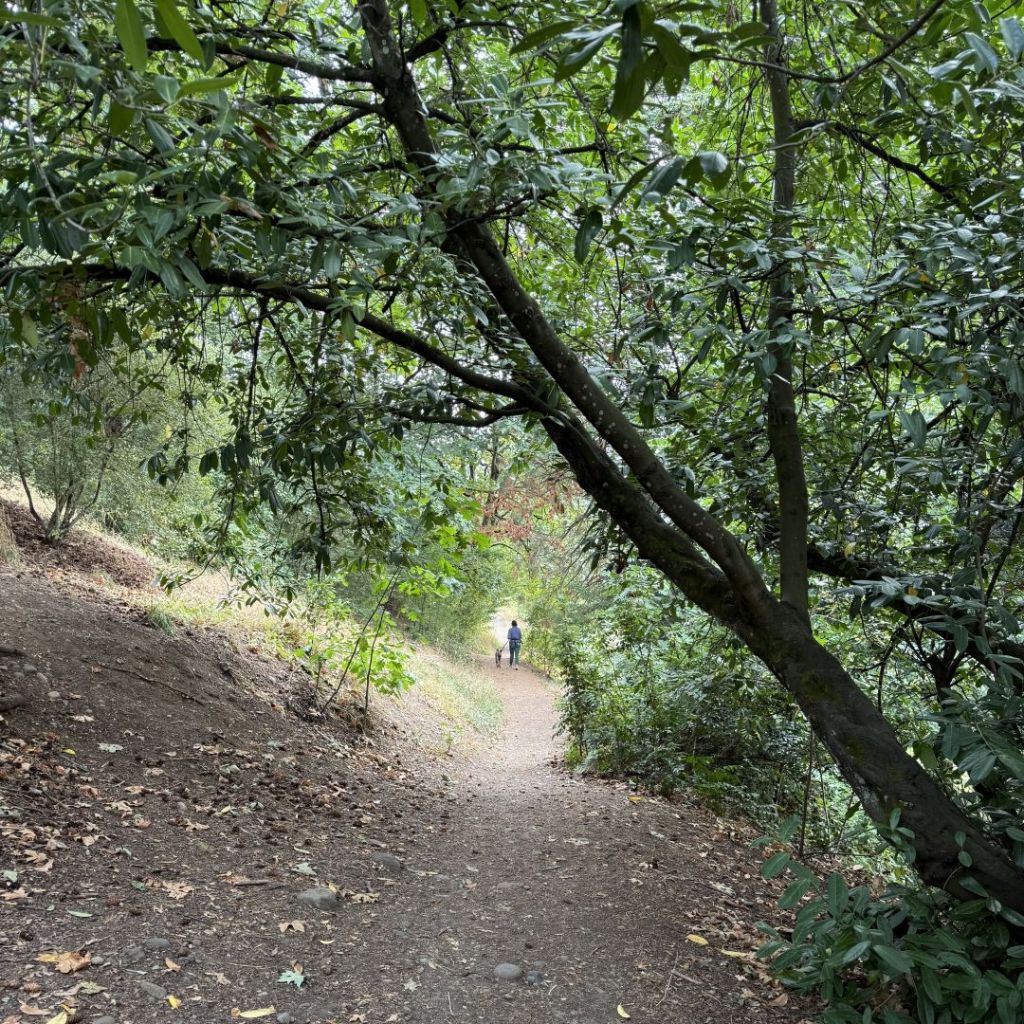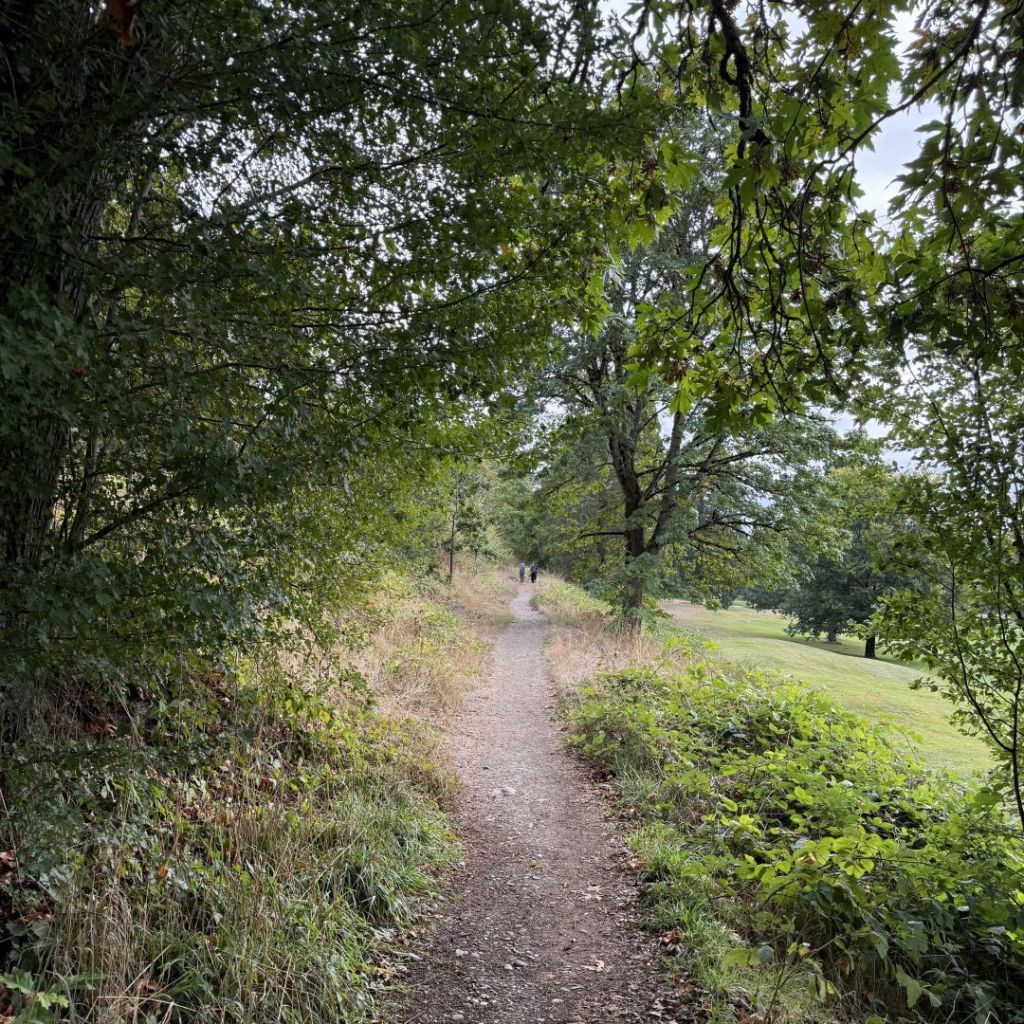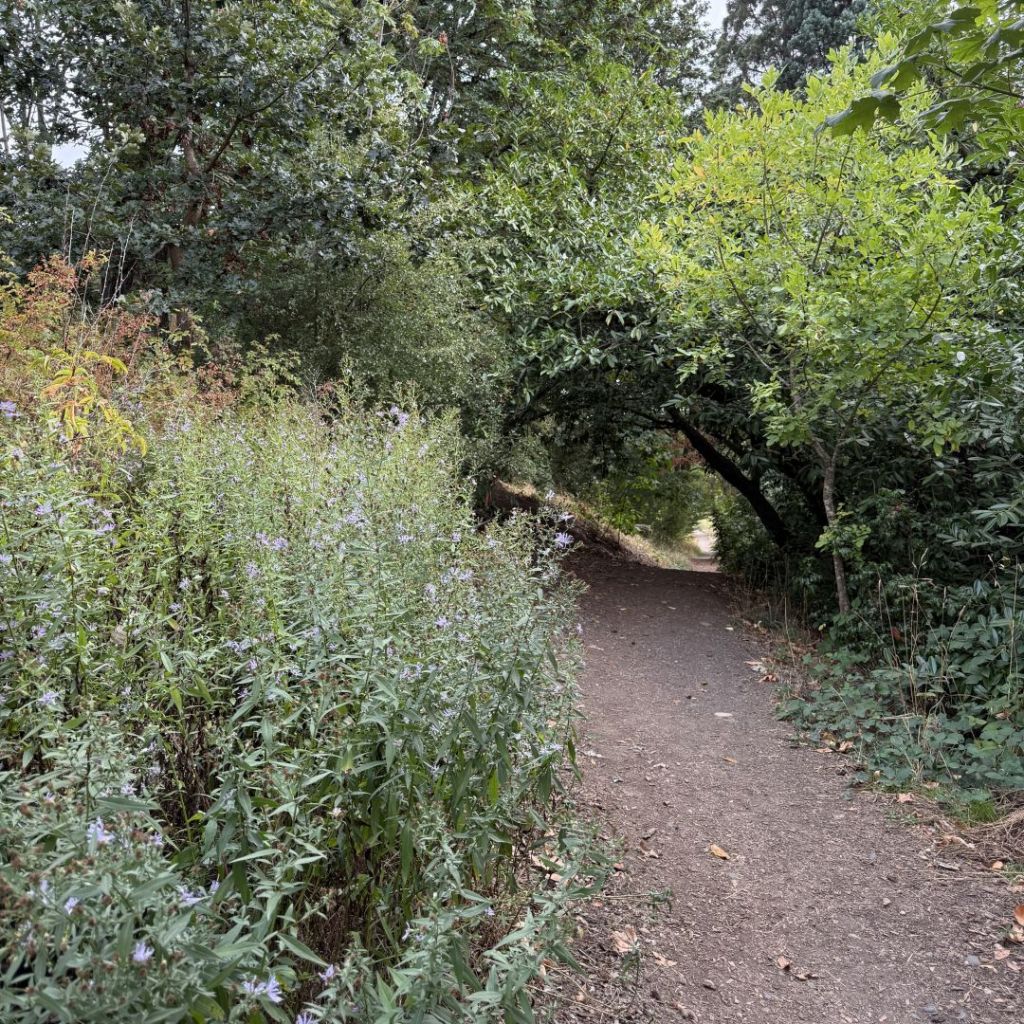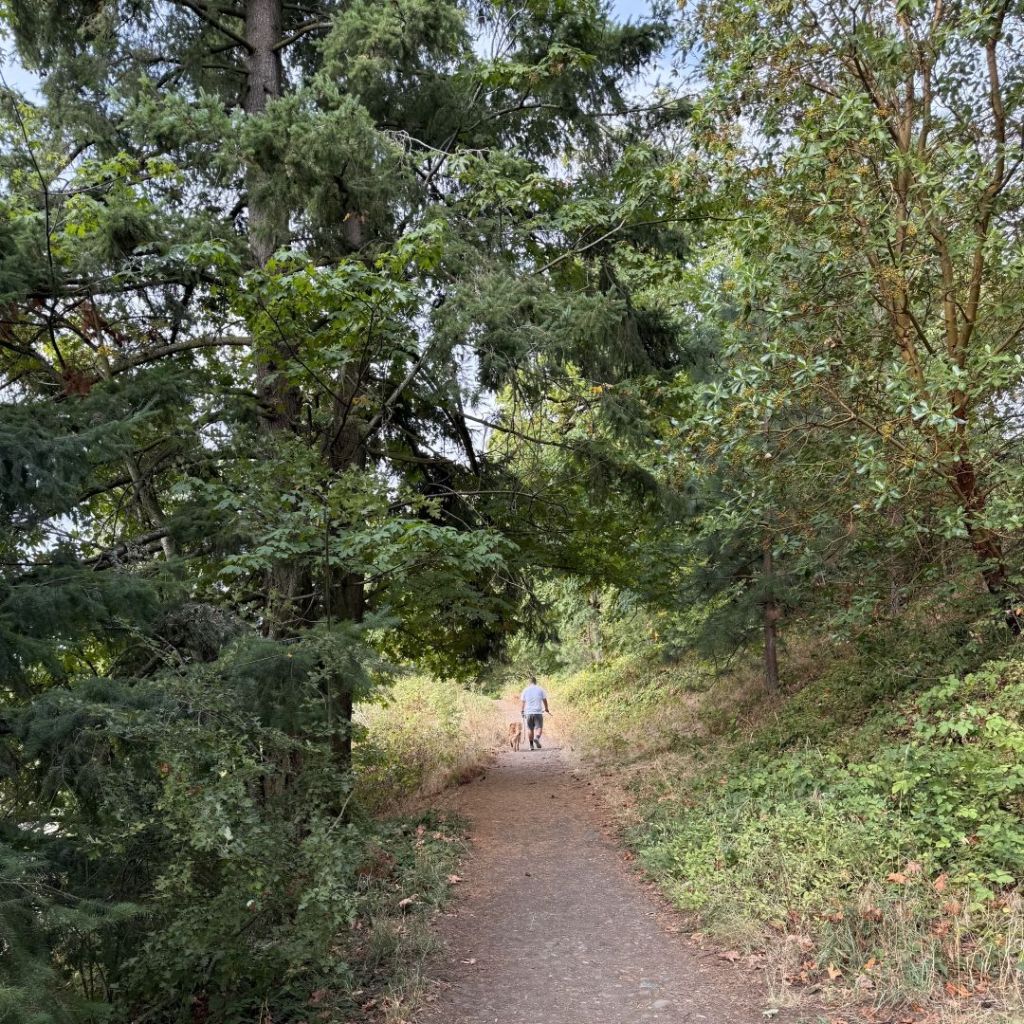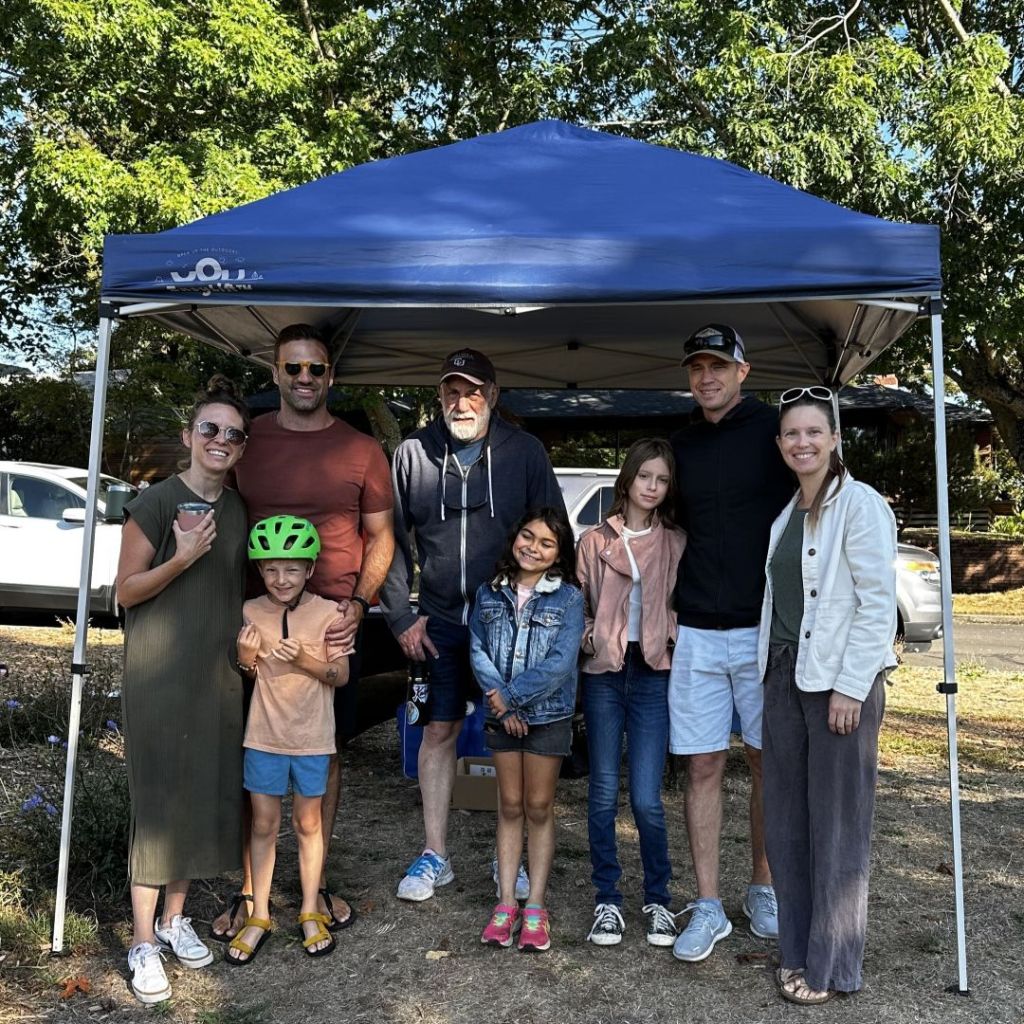
Both RCBR and the Pacific NW Community Supported Agriculture Coalition (PNW CSA) were at the Rocky Butte Farmers Market last Saturday. In speaking with PNW CSA’s Mary Silfven, we recognized that park restoration and CSA overlap, in values and in rewards. Park restoration creates beauty and biodiversity; community supported agriculture brings nourishment and resilience. Both endeavors create spaces where community, sustainability, and shared purpose flourish. We are especially drawn to the fact that CSA farms practice regenerative agriculture, a conservation and rehabilitation approach to farming. Regenerative farming focuses on topsoil regeneration, increasing biodiversity, enhancing ecosystems, increasing resilience to climate change, and strengthening the health and vitality of the land. (Wikipedia)
We invite you to check out PNW CSA. They can connect you with your local farmers. They have over forty farms serving the Portland area including the Cully Neighborhood Farm. PNW CSA also conducts helpful workshops like the Basics of Canning.
One more thing we have in common, as the folks at the Cully Neighborhood Farm say, our work “is hard, but it can also be incredibly rewarding in so many ways. This is why we keep doing it even though by conventional standards the pay is so low.” (Cully Neighborhood Farm blog)
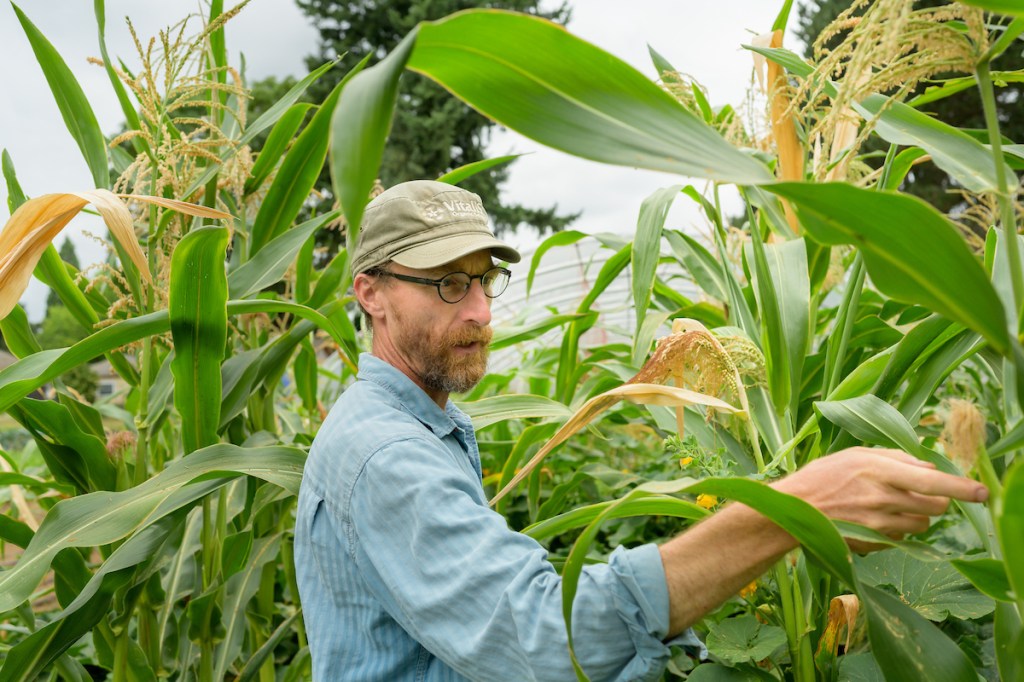
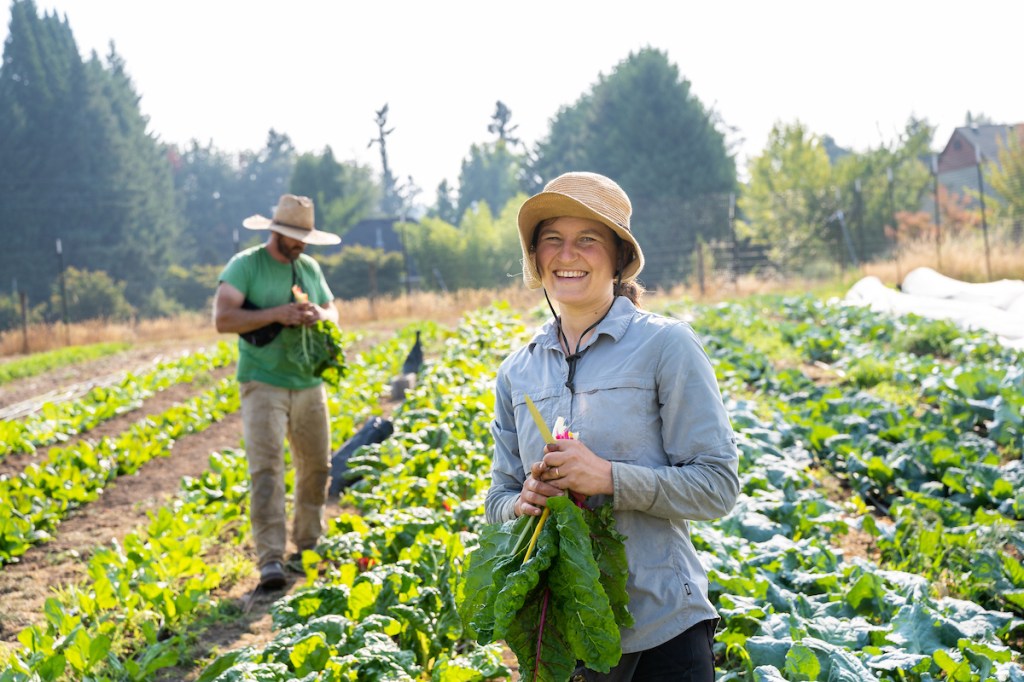
Cully Neighborhood Farm, Shawn Linehan PhotographerSun Love Farm, Oregon City, Shawn Linehan Photographer
This week we’re looking at community-driven projects in our neighborhood – in particular the Roseway Parkway Plaza, the Bird’s Eye Café, and the Rocky Butte Farmers Market – and how they have created great social gathering spots from small urban spaces. We were inspired to think about these people-friendly spaces by William H. Whyte’s 1980 movie, The Social Life of Small Urban Spaces. (Watch on Youtube.) Whyte started a revolution in urban planning and design when he published a book with the same name. His pioneering study of pedestrian behavior and city dynamics showed that social life in public spaces contributes fundamentally to the quality of life of individuals and society as a whole. Whyte believed that we have a moral responsibility to create physical places that facilitate civic engagement and community interaction.
Whyte subsequently shaped the work of some of today’s leading urban planners. The Project for Public Spaces founder and president, Fred Kent, worked as Whyte’s research assistant on the Street Life Project, conducting observations of corporate plazas, urban streets, parks, and other spaces in New York. Kent based PPS largely on Whyte’s methods and findings.
Whyte also influenced Jan Gehl, the Danish architect and urban design consultant whose career has focused on improving the quality of urban life by re-orienting city design towards the pedestrian and cyclist.
Jane Jacobs was an urban activist and author known for her influential book, The Death and Life of Great American Cities, which critiqued top-down urban planning and promoted community-centered development. When William H. Whyte was an editor at Fortune magazine, he invited Jacobs to author the article, “Downtown is for People” (1958), that launched her career and provided a platform for her groundbreaking ideas.
Though Whyte focused initially on major public and corporate spaces, his influence is now felt on community-driven urban spaces as well. The Bird’s Eye Café is a perfect example of Whyte’s observation in praise of small spaces: “The multiplier effect is tremendous. It is not just the number of people using them, but the larger number who pass by and enjoy them vicariously, or even the larger number who feel better about the city center for knowledge of them.” (William H. Whyte, emphasis ours.)
Bird’s Eye Café, NE Sacramento at 66th
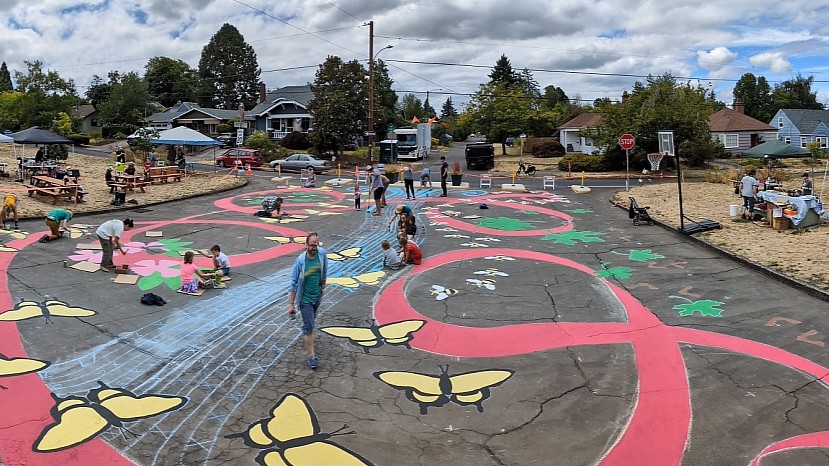
“The more successfully a city mingles everyday diversity of uses and users in its everyday streets, the more successfully, casually (and economically) its people thereby enliven and support well-located parks that can thus give back grace and delight to their neighborhoods instead of vacuity.” (Jane Jacobs, emphasis ours.) The Roseway Parkway Plaza, NE 72nd and Mason Street Plaza, once just an everyday street, is now a great place to facilitate civic engagement and community interaction.
Roseway Parkway Plaza, NE 72nd and Mason | Photo courtesy of Catherine Clark
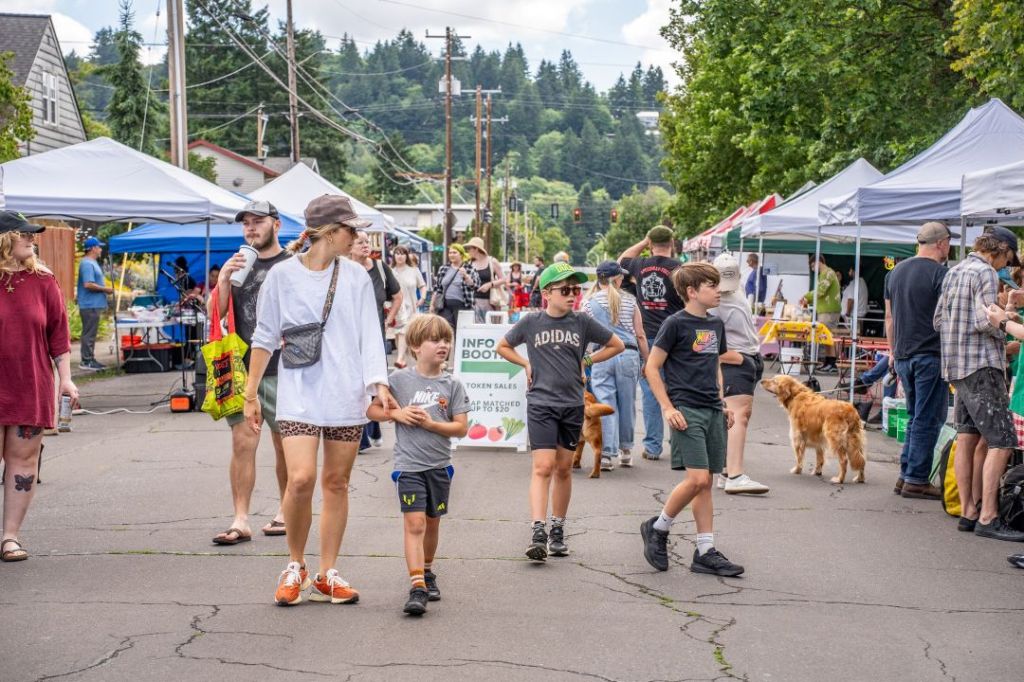
The Rocky Butte Farmer’s Market is our favorite place to spend a Saturday morning. We love how in its new location it transforms an otherwise mundane street into a market promenade. According to Jan Gehl, a key is to show people what their lives in the city could be like. “A good city is like a good party — people stay longer than really necessary because they are enjoying themselves.” (Jan Gehl, emphasis ours.)
Rocky Butte Farmer’s Market | Photo courtesy of RBFM
“Cities have the capability of providing something for everybody, only because, and only when, they are created by everybody.” (Jane Jacobs)
Moss grows all over Portland, thriving in the Pacific Northwest’s moist, shady conditions. Different mosses can have a global reach, be native to a region, or even be invasive. Oregon beaked moss (Kindbergia oregana) and cat’s tail moss (Isothecium stoloniferum) are common in the Portland area. While mosses in general are not listed on the Portland Plant List, there is an important ecological consideration regarding the trade and harvesting of certain mosses that grow in the Pacific Northwest. This practice has raised concerns about its potential ecological impact and the possibility of spreading invasive species.
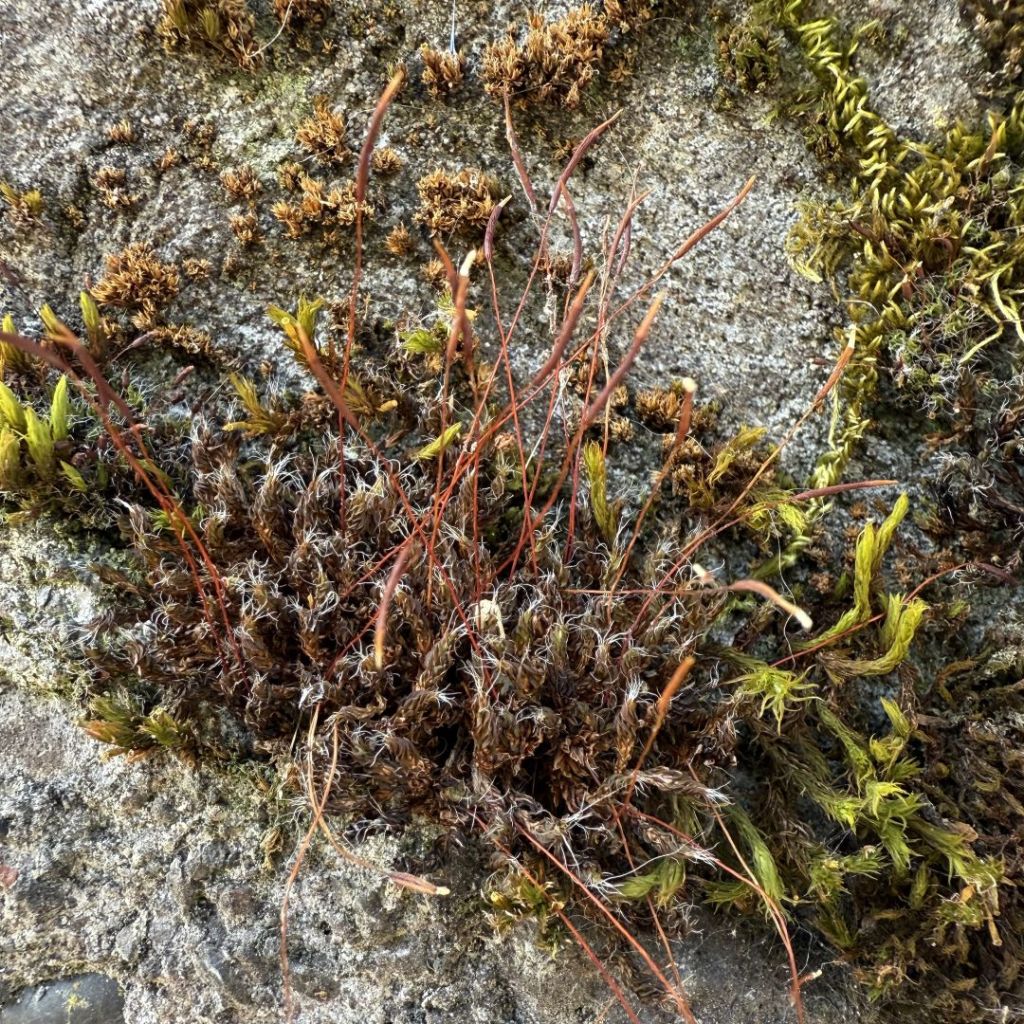
One of the most interesting things about moss, other than being a primitive non-vascular and flowerless plant, is that in its primary form (the green stuff we usually see) the cells are haploid – they contain a single set of chromosomes. The life cycles of primitive plants like moss and fungi are predominantly haploid. In more recently evolved plants like flowers, the emphasis shifts to the diploid. In a moss, the diploid stage is the sporophyte, including the thin stalk-like structure (see photo). The sporophyte is short-lived but produces spores. When these spores germinate, they grow into leafy green moss, starting the cycle over again.
Why should we care about moss? A recent study published in Nature Geoscience suggests that moss might also be important to climate change mitigation. Ecologists David Eldridge and Manuel Delgado-Baquerizo uncovered evidence that moss has the potential to store a massive amount of carbon in the soil. In fact, mosses sequester around 6.43 billion metric tons more carbon in the soil than is stored in the bare patches of soil without any plants typically found nearby them in global semi-arid areas. This is six times the annual worldwide global carbon emissions caused by deforestation, urbanization, and mining. While moss contributes to carbon sequestration it is also a soil stabilizer, a water retainer, and a habitat for small creatures. It is among the first plants to colonize disturbed areas.
Respyre, the Netherlands company, has come up with a technology to create moss walls and incorporate them into architecture more easily. First, they add a layer of porous concrete cladding to a wall. Then they apply a bio-gel that contains moss spores and the nutrients they need. This fast-tracks the natural processes that lead mosses to grow on walls.
You can create your own moss wall with a moss milkshake. This involves putting moss into a blender with buttermilk, yogurt, beer or potato water and enough water to make a thick consistency. Blend the mixture until it is like a thick milkshake or smoothie. Use a paint brush to apply to rocks, walls, or soil. Warning: this could be a tricky and messy process.
Want to know more? Here is a helpful podcast all about moss, and the ecosystem that lives in that tiny, fluffy world. Crisscrossing Science (Michael Crosser & Chad Tillberg, professors at Linfield University).
Take a walk down NE 72nd Drive — right after the sharp curve coming off NE Sacramento — and you will come upon a one-person restoration effort that has turned into something unexpected. The city created an opportunity when they cut down a blackberry thicket to survey the land for the Rose City Recreational Trail Project. A community volunteer took advantage of the potential for the area by digging out the blackberry roots and adding native plants like Oregon grape. Neighbors offered more native plants from their yards. And now the project has taken an exciting turn. Bigleaf maple seedlings have popped up everywhere! Now, this little restoration project is starting to look like a pocket forest in the making!
So, what is a “pocket forest“? Inspired by the work of Japanese botanist Akira Miyawaki, pocket forests are densely planted mini forests of native trees and shrubs designed to restore biodiversity and ecosystem health, fast. These urban forests grow quickly, support pollinators and birds, and help people reconnect with nature right in their neighborhoods.
Groups like SUGi are creating pocket forests around the world to boost biodiversity, improve soil, and even bring communities closer together. As they put it: “We create ultra-dense, biodiverse pocket forests of native species only.” SUGi’s projects are restoration rooted in community and climate resilience.
The 72nd Drive project will not be a true Miyawaki-method forest which requires planting the area with year-old saplings spaced approximately two feet apart, all at the same time with a variety of native species so no saplings of the same species are adjacent to each other. The close spacing is meant to create competition for sunlight, encouraging plants to grow up quickly rather than out. Nevertheless, we are excited about the potential for the 72nd Drive project to teach us something new about restoration work.
Why does this matter for us? As local temperatures rise, there is growing concern about heat islands. In our community that includes NE 82nd Avenue. On July 22, Oregon Metro, Oregon Walks, and APANO hosted a community workshop to brainstorm ways to cool down 82nd Avenue for residents’ health and safety. Pocket forests might be one powerful answer. They are shady, green, and filled with life — everything a street or neighborhood needs to breathe a little easier in the summer heat.
A tour of the Bluff sometimes leads to discussions about its urban biodiversity: the pollinator plants, the habitat, and the exceptionally large trees. Visitors can’t help but notice Northwest natives in the understory and the giant sequoias, the Oregon white oak, Douglas firs, and big leaf maples above.
The giant trees contribute to heat mitigation and air quality, which are mostly local effects. They also play a big part in the broader, non-local effects, particularly carbon sequestration. Being curious about the science behind the contributions of our large trees we came across an article, “Saving Trees Too Big to Hug.” Research by David Mildrexler with contributions from Logan Berner, published in 2020, examined “the proportion of large-diameter trees (21 inches or greater) on National Forest Lands in the Pacific Northwest, and the disproportionally large carbon storage of these trees compared to smaller ones. The research revealed that these large trees store massive amounts of carbon, highlighting their ecological importance in mitigating climate change.
“Although representing only about 3 percent of all trees in the study area, these large trees accounted for about 42 percent of the above-ground carbon storage in the forests, making them significant in the context of a warming climate by keeping that carbon out of the atmosphere.”
Bluff visitors are also apt to notice the variety of Northwest native understory plants that grow below the tree canopy: Oregon grape, snowberry, ocean spray, and red flowering currant. Most of the mature Northwest natives came from an effort undertaken around 2001 when the late Jim Heck, the Rose City Golf Course superintendent, and the city partnered with neighborhood volunteers to replace invasive plants on the Bluff with Northwest natives. Many of those plants survived the overwhelming spread of blackberry thickets that followed. As a place to connect with nature, the Bluff benefits hugely from these mature Northwest native understory plants and the sheltering large trees above.
It turns out that the lead author of the paper describing the study of large trees, David Mildrexler, grew up in the Rose City Park neighborhood and was a volunteer on the 2001 Bluff restoration project! David now resides in Eastern Oregon where he is the Systems Ecologist at Wallowology, the public education and outreach division of Eastern Oregon Legacy Lands, whose mission is to expand land conservation in Eastern Oregon through public education, landscape-level planning, and land acquisition. We recently contacted David, and he would like everyone to know how happy he is that volunteers are restoring the Bluff and building community in his old hood.
Read more about the science behind “trees too big to hug” here:
“Protect large trees for climate mitigation, biodiversity, and forest resilience”
Locomotion: We have briefly looked at tiny pollinators found on the Bluff goldenrod flowers. The margined calligrapher fly and the common compost fly we observed are both hoverflies, known for their ability to hover in mid-air. They approach and hover before goldenrod flowers, as if evaluating where to land. We now want to point out a couple of other species with interesting locomotion abilities. Both of our examples were observed on Queen Anne’s Lace, also known as wild carrot (Daucus carota). It’s a Rank C nuisance plant on the Portland Plant List, but it’s ubiquitous here in Portland and elsewhere.
Our first example is Misumena vatia, commonly called the goldenrod crab spider. We spotted it on Queen Anne’s lace though it is a frequent visitor to goldenrod and milkweed. It’s called a crab spider for its unique ability to walk sideways. They also can change their color to blend with their surroundings. Hence, we saw a mostly white spider on the white flower.
Goldenrod Crab Spider, Rose City Bluff
Our second example, also seen hanging out on Queen Anne’s lace, is a tiny tumbling flower beetle in the family, Mordellidae. We’re not beetle-smart enough to know what species we observed. We may have a tumbling nun (Mordella melaena). It appears unimpressive at first — simply small and solid black. However, tumbling flower beetles possess an interesting locomotion skill. Their name comes from their erratic escape movements. The apparent tumbling movements are a series of very rapid jumps powered by one leg. A different left or right leg used as the leverage for take-off changes the direction of the jump.
A walk along the Bluff this month will reveal that the pollinators are taking full advantage of what the Rose City Bluff Restoration community of growers and fall planters have done to increase the supply of native flowering plants. It is impossible to miss all the bumblebees visiting the California poppies, goldenrod, and other flowers. A close look at our goldenrod (Solidago) has given us an appreciation of the smaller pollinators as well. These tiny bees or flies are no more than 8mm long, but they are as beneficial as the big bumblebees. Here are three examples that we recently found on the goldenrod.
First up, a little bee in the genus Lasioglossum, commonly called sweat beesfor their attraction to perspiration. We have trouble remembering the scientific names, but in this case consider that in botany the prefix lasio means “hairy” and glossum is of course “tongue.”
Lasioglossum
Our second example is a hoverfly, the Syritta pipiens, in the family of Syrphidae, commonly called hover or flower flies. This species is known as the thick-legged hoverfly or common compost fly, because its larvae develop in decaying organic material such as manure and garden compost.
Syritta pipiens
Thirdly, we have another hoverfly, the Toxomerus marginatus, common name margined calligrapher fly. The abdomen markings give away its name.
As the Rose City Bluff Restoration volunteers go about their work each weekend there’s much discussion about plant life on the bluff, both the native and the invasive that we attempt to control. Let’s look at a couple of organisms that don’t get much attention – mosses and lichens. We don’t focus our restoration efforts on mosses or lichens of course, but up close we find them to be every bit as beautiful as many of our native flowering plants. And it turns out that like our plants they can be native, non-native, or even invasive.
We’re used to lumping mosses and lichens together as those things that grow on trees, also known as epiphytes. Wikipedia tells us an epiphyte is a plant or plant-like organism that grows on another plant but is not parasitic. But wait, mosses are plants, but lichens are not and they’re only superficially plant-like. When mosses grow on rocks are they still epiphytes? Thanks to (full disclosure) ChatGPT we confirmed that both mosses and lichens can be epiphytes, but epiphytic is a lifestyle, not a thing. Mosses and lichens are epiphytic if they’re growing on a living plant. When they grow on rocks, they are epilithic. On logs, they’re epixylic.
Here are a few other things we learned. Phorophytes are plants (or is it a lifestyle?) on which epiphytes grow. Our bigleaf maples (Acer macrophyllum) along with the vine maples (Acer circinatum) make great phorophytes. The photos below are of the lichen, Xanthoria parietina (common sunburst lichen) and Dendroalsia abietina (Dendroalsia moss). Dendroalsia moss is native to the Pacific Northwest. Common sunburst lichen is not native to our area, but it is also not invasive.
Rose City Bluff Restoration volunteers have been exchanging thoughts and speculation about the habits of our coyotes that live on the Rose City Golf Course. They are such mysterious creatures it’s not surprising that we often wonder what they’re up to but seldom really know. Thanks to our volunteer, Donia Kate, for alerting us to a presentation on urban coyotes last Thursday hosted by the Bird Alliance of Oregon. This answered a lot of our questions about coyote behavior. You can see a version of the same presentation on YouTube here: https://www.youtube.com/watch?v=UZqYFrRpqzA
The presenter, Dr. Stan Gehrt, is principal investigator of the largest and longest study of coyotes in the Chicago area, which has involved the monitoring of over 1600 coyotes over a 25-year period. In this presentation he discussed things learned from these animals living among millions of people, such as how they move across the landscape while avoiding us, how they interact with each other, and how they function as predators in the urban ecosystem. If you are the least bit curious about our urban coyotes, we highly recommend Gehrt’s presentation. Spoiler alert, we even learned that the Chicago coyotes are monogamous. We’re not going to speculate about that regarding the Portland coyotes.
If your curiosity is piqued, we also recommend The Voice of the Coyote, by J. Frank Dobie, first published in 1949. Because it seems particularly relevant to speculation about the behavior of coyotes (particularly the rural variety), we pass along this quote from Dobie’s book: “The ‘infinite variety’ cultivated by the coyote while adapting himself to changes in environment has probably been characteristic of the species from remotest times. Then as now, the coyote was flexible in hunting habits, killing for himself, accepting refuse from bigger killers; diurnal as well as nocturnal, taking his chance at wood rats out by night, at prairie dogs out only in daylight, at jack rabbits stirring mainly in the evening; sleeping by day on a full belly, hunting by day on an empty belly; in the desert digging for prickly pear roots, on the edge of a swamp slipping up on frogs as skillfully as a coon; no more fixed to one spot of ground, like a wild mare bent on foaling at the same spot annually, than fixed to one habit of eating; careless by nature, careful under necessity.” (Dobie, 1949, p. 39)
We have been hearing lately about how our NE Portland neighborhoods (Rose City Park, Roseway, Madison South) are so well organized and engaged. The neighborhood associations and the grass roots projects within do wonders for our community. With the Rocky Butte Farmers Market season opening today we thought it would be appropriate to share an article about the need for spaces like public markets when things are not so great. This is a story about what we have done for fun, for connecting with each other, and for building community, becoming so important when things go south. It is a reminder that what you are doing to create spaces for people is invaluable in times of need.
The article “Where We Go When Everything Breaks” by Ryan Smolar, published on May 16, 2025, on the Project for Public Spaces website, examines how the design of public spaces influenced Asheville, North Carolina’s response to Hurricane Helene in September 2024. Smolar, Director of PlacemakingUS and Consultant to Thrive Asheville, highlights that communities with established, walkable public spaces such as markets, churches, and community centers were effective in organizing relief efforts and fostering solidarity. Conversely, areas characterized by urban sprawl and a lack of communal spaces faced challenges in coordination and support. The article underscores the importance of public spaces that serve as critical infrastructure during crises, facilitating not only logistical support but also emotional resilience and community cohesion.
We highly recommend this article if for no other reason than you will learn about “toilet angels.”