Rare Bird Sighting

Birders take note! Thanks to Trask for the following great story about a rare (for us) bird.

Last weekend (10/7/23) a new bird, the Pygmy Nuthatch, was seen at Rose City Golf Course. Our bluff is home to many Red-Breasted Nuthatches. Listen for their “neeern neeern neern” call as they look for food. They’re quite common at bird feeders in the neighborhood. There are also two White-Breasted Nuthatches that hang out at our bluff, though they are rarer in the city and always a good find. The Pygmy Nuthatch, however, has only been seen in Multnomah County once before. Last weekend as many as five Pygmy Nuthatches found their way to our bluff and the nearby homes, a remarkable discovery by visiting birder Brian MacDonald!

What caused this bird to show up here? Irruptions. Irruptions are periodic autumn/winter invasions of birds in search of food. Perhaps the most famous of these irruptive birds is the Snowy Owl, which every few years heads south from the Arctic in search of food. There are also finches, like Pine Siskins, Evening Grosbeaks, Common Redpolls, and Pine Grosbeaks. However, it seems this year the valley is getting some birds that normally live on the east side of the state to come over here. We should expect more Pygmy Nuthatches through Western Oregon.

The Pygmy Nuthatch likes long-needled pine trees, like Ponderosa Pines, and actively calls with a high-pitched squeak. Keep your eyes and ears open, and you may find them too. They may stay all winter, or they may be gone by the time you read this. It can be tough with irruptive birds, but for now we’ll enjoy the excitement as dozens of birders visit our bluff in search of the Pygmy Nuthatch.

Thanks to Audrey Addison for the photo of the Pygmy Nuthatch.

Nurse Logs

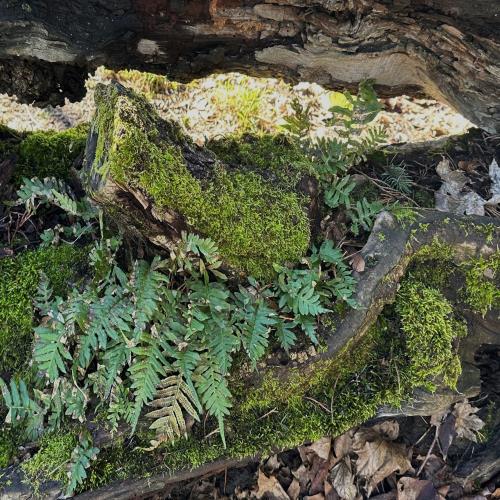
Here’s another new (to us) phrase: the nurse log. A nurse log or nurse stump is a fallen, decaying tree that supports seedlings, moss, mushrooms and other small plants. The Rose City Bluff has a number of fallen trees and the recent weather has added a few more. We hate to lose trees but love that even when fallen they provide for new growth. When Rose City Bluff Restoration volunteers receive piles of wood chips we often take a few logs as well. These are then placed on the bluff to serve as nurse logs. The coarse woody debris, plant litter, and nurse logs distinguish areas like the bluff from manicured park settings. 

Ethical Birding

Thanks to Trask for the following cautionary story and photo: Recently a neighbor sent us a picture of a Western Screech Owl, a great find! As someone who birds the bluff a couple of times a week, just one picture was enough for me to know where to look. Sure enough the next day I found the screech owl, perched in a cavity.

I shared this photo with my friends at the bluff and included the picture on ebird. The next day I received an email from a stranger asking for the location of the owl, so he could take pictures. Here lies the problem with sharing information about owls. No doubt owls are the absolute coolest of the birds we have in the PNW, if not everywhere. Having only seen a handful of Screech Owls (including 3 times at the golf course) I know the allure of seeing these amazing birds! We kept the location of the bird secret, as I had hoped the cavity would contain a nest, and though it ended up not being a nest, keeping it secret was the right thing to do.
Surprisingly Western Screech Owls are likely to be the most common raptor in the city of Portland. They are in most large parks, graveyards, and neighborhoods with many old trees (think Laurelhurst). Nonetheless, as all birds face significant declines, it is important that we approach sharing information about owls carefully.

Here are some important things to consider, from the Chicago Audubon Society, when it comes to owls:
– Don’t get too close – if the owl looks at you frequently, you’re too close.
– Stay on “the sidelines” and don’t enter an open area where an owl is hunting.
– Use binoculars or a scope for viewing and a telephoto lens for photography.
– Use a blind to minimize your presence – your car or even just hide behind a tree.
– Do not intentionally “flush” an owl.
– If you use audio recordings, minimize their impact on birds, and follow the ABA Code of Birding Ethics.
– Use discretion when sharing the location of an owl; usually it’s best to provide details only to people you can trust to treat the owl safely.
– Avoid the use of flash photography, especially after dark.
– Eliminate noise to avoid interfering with a bird’s auditory hunting. If you’re viewing from a car, turn off the engine; if you’re with others, talk in a whisper only when necessary.

The person who shared the original photo with the bluff did absolutely nothing wrong. They found an awesome bird and shared it with people who can be trusted. I followed the rules for dealing with owls and the Audubon’s guide to ethical bird photography: https://www.audubon.org/get-outside/audubons-guide-ethical-bird-photography

I hope our followers and volunteers continue to share their sightings of owls, hawks, and other cool plants/animals seen on the bluff. As the bluff gets more amazing and more people come to visit, it is important for us all to remember to be the best stewards of our environment as we can be.

Cedar Tree Learning

Rose City Bluff Restoration thanks all our volunteers who have helped transform the bluff into a special learning environment. This Earth Day Cedar Tree Learning hosted a walk for kids that included plant identification, naturescape art and exploration. Two more Cedar Tree Learning trail walks will be scheduled this summer. And RCBR is hosting a bird walk for kids, May 21, 2023.

Sunken Lane

You’ve probably experienced the serenity of a walk along the Rose City Bluff lower trail. Somewhat like a canyon trail, the slope rises to your side. Vegetation is close and the city is obscured. A term for similar trails in Europe and elsewhere is sunken lane or hollow way. (Wikipedia) The bluff trail is just a half-hollow way, and wasn’t created by foot and wagon traffic. However, the overall effect, being down low with a green embankment to your side, is much the same. “Sunken lanes have a large touristic potential because of their many values and functions: i.e. scenic beauty (reflected among others in paintings), recreational (hiking, biking), scientific (biodiversity, geomorphology), educational and geoheritage.” (Sunken Lanes, Earth Science Review.)

Claude Monet, The Sunken Road in the Cliff at Varengeville

Fall Planting, 2022

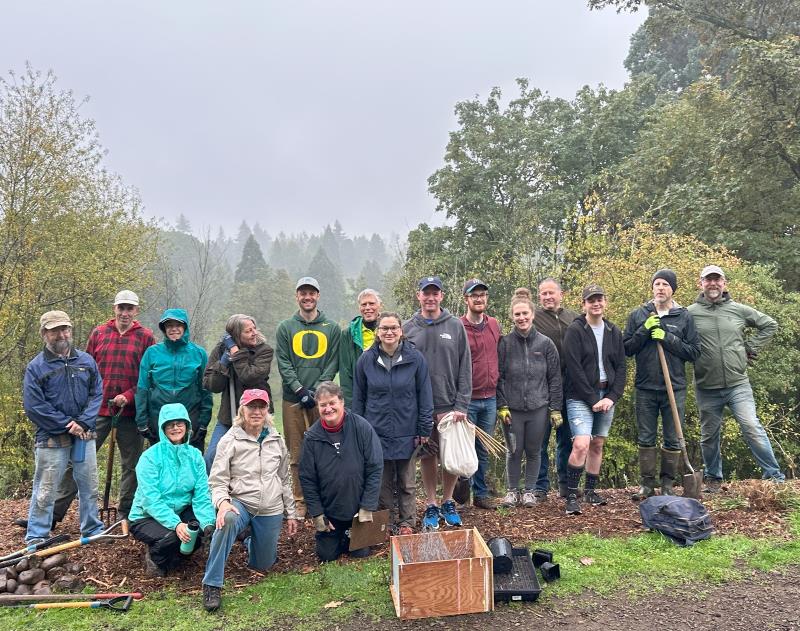
Many thanks to our wonderful volunteers who showed up last Sunday in the cold and rain for our second annual Fall Planting Day! They planted over 400 native trees, shrubs and perennials, all volunteer grown from seed or transplanted from their gardens. As you walk the trail next year look for new lupine, self heal, Oregon sunshine, blue wild rye, shade phacelia, pearly everlasting, and many others.

Thanks to Suzanne for this cool photo of a few of the 35 folks who came out for Fall Planting Day 2022.