Bare Root Potting Party

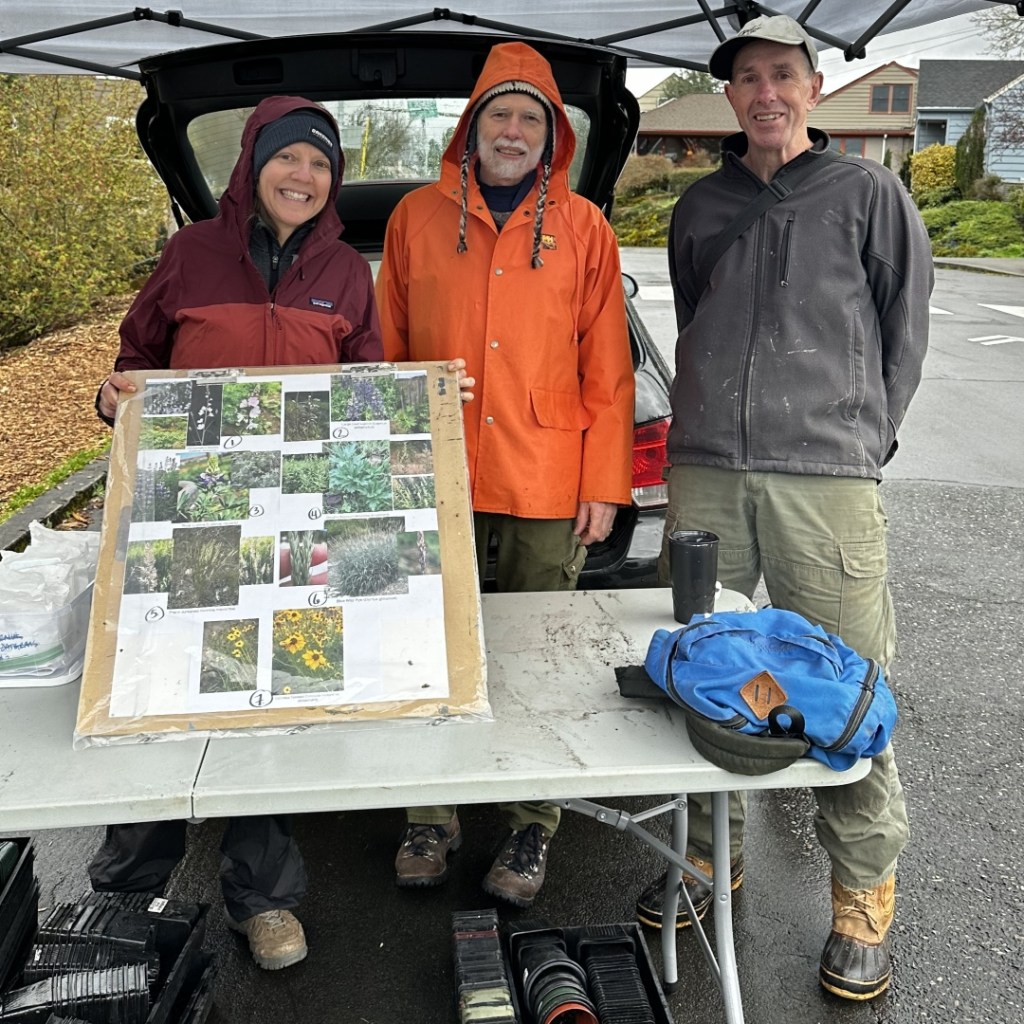
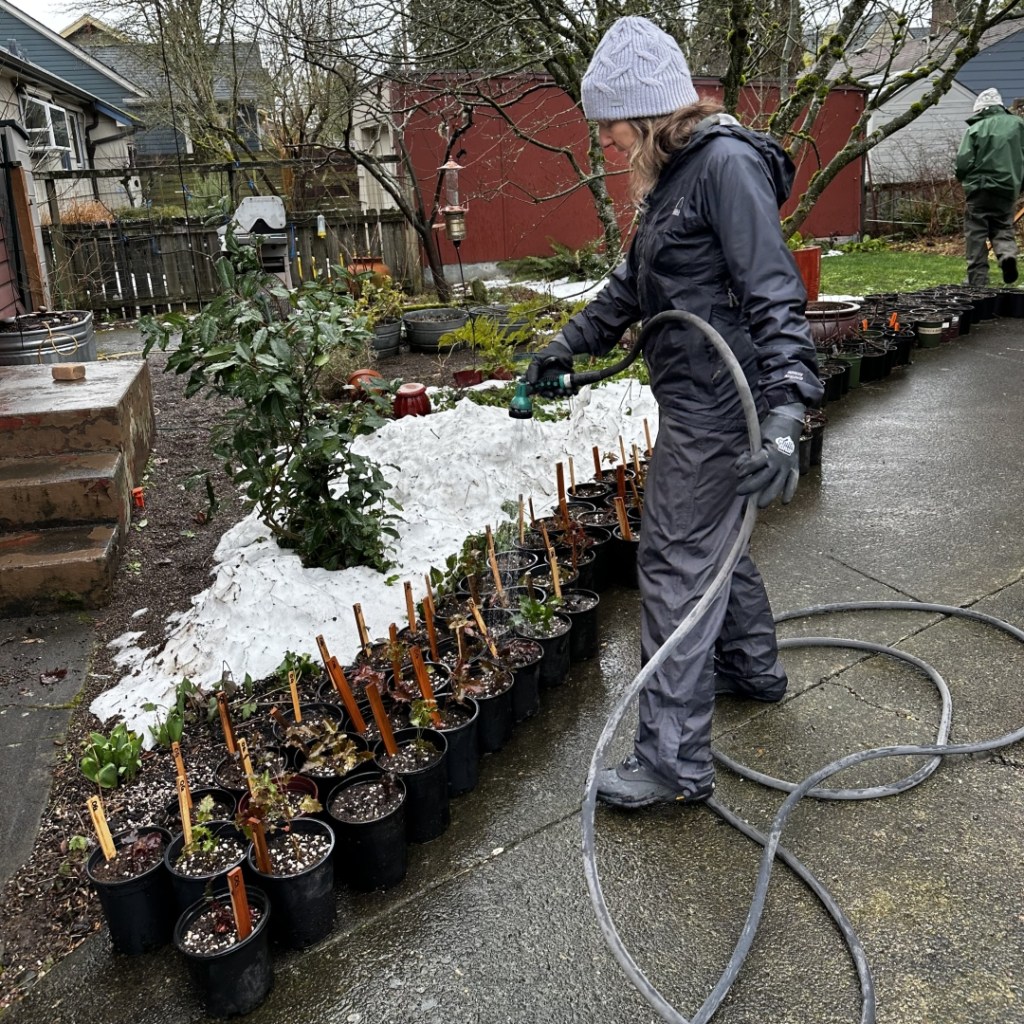
Rose City Bluff Restoration held its second annual potting party on February 16, 2025. Twenty-six volunteers potted over four hundred Northwest native plants that they will add to the Bluff next fall. Those same volunteers kindly took home a selection from the twenty species of plants and will care for them until the fall planting. These plants potted from bare roots are in addition to plants raised from seeds. Thanks to all our volunteers who participated on Sunday! We extend a special thanks to Reed and Marcelle for all their preparation. They spent weeks selecting and acquiring plants and supplies, then organized the complex process of bringing them all together with our volunteers.

We’re really excited about the plant selection as this will enhance the Bluff understory:

  • Baldhip Rose (Rosa gymnocarpa)
  • Blue Elderberry (Sambucus cerulea)
  • Narrow-leaved Buckbrush (Ceanothus cuneatus)
  • Cascara (Rhamnus purshiana)
  • Common Chokecherry (Prunus virginiana)
  • Mock Orange (Philadelphus lewisii)
  • Ocean Spray (Holodiscus discolor)
  • Oregon Grape (Mahonia aquifolium)
  • Oregon White Oak (Quercus garryana)
  • Osoberry (Oemleria cerasiformis)
  • Oval-leaved Viburnum (Viburnum elipticum)
  • Red Elderberry  (Sambucus racemosa)
  • Red Flowering Currant (Ribes sanguineum)
  • Red Stem Ceanothus (Ceanothus sanguineus)
  • Salmonberry  (Rubus spectabilis)
  • Serviceberry (Amelanchier alnifolia)
  • Snowberry (Symphoricarpos alba)
  • Suksdorf’s Hawthorn  (Crataegus suksdorfii)
  • Vine Maple (Acer circinatum)
  • Western Crabapple (Malus fusca)
Bare Root Plant Potting 2025

Phenology

Plant phenology refers to the study of the timing of recurring biological events in plants, such as leafing, flowering, fruiting, and germination. Seasonal temperature and day length changes influence these events. Phenology is a crucial aspect of ecology because it affects various ecological interactions, including plant-pollinator relationships, species competition, and the synchronization of plant life cycles with those of herbivores. Phenological observations provide valuable insights into how plants respond to climate change. For example, earlier leafing and flowering times can indicate warming temperatures. By tracking phenological events, scientists can better understand and predict the impacts of climate change on ecosystems.

This is the time of year that our Rose City Bluff Restoration seed project volunteers are planning on what to add to the bluff, when to plant, and where plants will have the best chance to thrive. Additionally, these volunteers give much consideration to seed germination, a key factor in plant phenology. Our RCBR seed project leaders also ponder the question of environmental change. What plants might do well or not so well as the Pacific Northwest climate evolves? They are in effect engaged in the practical application of plant knowledge overlapping one of the goals of phenology, to understand how a changing environment impacts plants.

You can participate in phenology research by making phenological observations in the iNaturalist application. Your observations with phenology annotations can assist researchers who use phenology data to study climate change. You can observe plant phenology events specifically for the Bluff; RCBR maintains its own iNaturalist project. You can also make observations for plants in your yard. Since each observation has a location and date your annotation becomes phenology data for researchers.

If you would like more in-depth information on phenology, iNaturalist has a webinar which covers why phenology is so important, examples of phenology research using iNaturalist data, and how you can help by adding flower and leaf annotations.

iNaturalist Phenology Annotation: Flowers

Seed Project 2025

As we enter the new year, let’s resolve to grow more native plants for the Bluff! Many of you participated last Spring in sowing a variety of native seeds which resulted in over 800 plants added to the Bluff in November. To ready us for this year’s seed sowing, check out this informative podcast: https://joegardener.com/podcast/easiest-way-start-grow-native-flower-seeds-winter/

While it is based out of the east coast, the tips are relevant, including, native seeds:

  • are easier to work with vs domesticated/cultivated/vegetable seeds.
  • do not need to be sown under lights or in a greenhouse.
  • are overall less fussy in their soil requirements (do not require compost, manure, weeding to thrive).
  • can be sown in a small 4″ pot and transplanted to a larger pot when needed. Separating individual starts is discouraged as it disturbs root growth. If needed, divide in half or quarter sections.
  • once established, starts can benefit from a weak seaweed solution fertilizer.

Check out the podcast. We’re sure you’ll capture even more helpful suggestions.

We will have seeds and supplies again this Spring. If you are interested in growing native plants from seed this year, please contact Marcelle directly at marcelle1212@gmail.com.

Rose City Bluff Restoration, Native Seed Project, 2025

2025 Resolution 

Make your New Year’s Resolution to get up close and personal with the beautiful bluff. Please consider joining the RCBR volunteers in 2025. Work off some holiday calories with other amazing folks. In 2024 our volunteers contributed 900-plus hours to the bluff restoration. Over seventy volunteers participated. On planting day, forty volunteers added eight hundred native plants to the bluff’s “natural” areas. Please join us in 2025 and fulfill your New Year’s Resolution.

Rose City Bluff Madrone 2024
Harefoot Mushroom

Please check out more bluff close-ups on Instagram.

Marcescence

Rose City Bluff has about ten small oak trees east of what we call the Overlook, at NE 66th Street. In December, when other trees have dropped or will soon drop their leaves, these oaks hang on to their leaves. The name for this phenomenon is marcescence. Oak leaf marcescence is senescence without abscission. Why this happens we don’t really know. Is it stubbornness? Defiance? Maybe reluctance, as suggested by Robert Frost’s poem, Reluctance, published in 1913:


Out through the fields and the woods
   And over the walls I have wended;
I have climbed the hills of view
   And looked at the world, and descended;
I have come by the highway home,
   And lo, it is ended.

The leaves are all dead on the ground,
   Save those that the oak is keeping
To ravel them one by one
   And let them go scraping and creeping
Out over the crusted snow,
   When others are sleeping.

And the dead leaves lie huddled and still,
   No longer blown hither and thither;
The last lone aster is gone;
   The flowers of the witch hazel wither;
The heart is still aching to seek,
   But the feet question ‘Whither?’

Ah, when to the heart of man
   Was it ever less than a treason
To go with the drift of things,
   To yield with a grace to reason,
And bow and accept the end
   Of a love or a season?

Oak Leaf Marcescence, Rose City Bluff, 12/24
Rose City Bluff, 12/24

The High Line

We recently had the pleasure of walking the High Line in New York City, once one of the most unnatural spaces imaginable. It was an abandoned elevated rail line 30 feet above street level. It is now a 1.4-mile-long linear park with natural landscaping. It’s not limited to native plants, but the plant selection was inspired by plants which grew on the disused track. The High Line is only 30–50 ft wide and 18–24 inches deep, but it features about 400 species of plants. It attracts millions of visitors annually and has inspired cities throughout the US to create public spaces from obsolete infrastructure. The High Line’s creation was community driven. A nonprofit organization called Friends of the High Line was formed in 1999 by Joshua David and Robert Hammond, who advocated its reuse as public open space. They completed the first phase in 2009.

Walking the High Line on a busy fall afternoon the dry and browning plants were captivating. One of the informative signs says High Line horticulturists prioritize plant form and structure: “Rather than selecting plants for their short-lived blooms in peak season, the full annual lifecycle of the plant is considered — including the beauty of their skeletal forms in winter.” We’re often struck by how great our bluff looks in winter, as well.

Trailing Blackberry

Rose City Bluff Restoration is lucky to have at least two areas with a healthy coverage of trailing blackberry (Rubus ursinus). We don’t know if it was seeded by birds, nor do we know if it appeared before or after 2001 when former Rose City Golf superintendent, Jim Heck, spearheaded a significant restoration of the bluff. Though we haven’t planted any trailing blackberry ourselves, we encourage it by managing the Armenian blackberry that wants to take over. Thankfully, we have the space for this native blackberry.

Rose City Bluff trailing blackberry (Rubus ursinus)
Rubus ursinus

Heart Rot

A few weeks ago a large maple tree trunk fell. This wasn’t a surprise since it had been looking well past its prime for as long as we’ve been doing bluff restoration. We think it succumbed to heart rot: “Heart rot is a fungal disease that causes the decay of wood at the center of the trunk and branches. Fungi enter the tree through wounds in the bark and decay the heartwood. The diseased heartwood softens, making trees structurally weaker and prone to breakage. A good indication of heart rot is the presence of mushrooms or fungus conks on the tree. . . The fungi only target the nonliving wood tissue of the heartwood and do not affect the living sapwood. Initially, infected heartwood is discolored but not structurally compromised. As the fungi grow they decay more wood and the tissue becomes increasingly soft and weak. The tree can still grow around the decayed heartwood because the live wood tissue is not affected. The growth around decayed areas of heartwood creates structural weaknesses in the tree. Trees with extensive decay are more susceptible to broken branches and trunks.” (Wikipedia)

Heart rot in recently downed maple

Good indication of heart rot – fungi

Scary

It’s Halloween! We thought it would be fun to learn about (and perhaps demystify) some of the scariest things on the bluff, because SPIDERS! So, here’s a little Halloween quiz for you. See if you can match the following scary substances with the plant or arthropod. NOTE: We haven’t actually seen black widow spiders on the bluff but they are in Oregon. Otherwise, watch out where you step and be careful what you eat!

Match each one of these substances: a. Phospholipase A (this enzyme can cause cells to rupture), b. Urushiol (found in sap of the Chinese lacquer tree and other plants), c. Juglone (think allelopathic), d. Atropine and Scopolamine (think belladonna), e. Latrotoxin (latro suggests a mercenary or bandit);

With one of these plants or Arthropod: 1. black widow spider, 2. wasp, 3. black walnut, 4. deadly nightshade, 5. poison oak.

By Kazvorpal, Wikipedia

Answers: a-2, b-5, c-3, d-4, e-1. Phospholipase A, wasp and bee venom. Phospholipase A (PLA) is an enzyme found in wasp venom that can cause cell lysis (rupture) and inflammation. Urushiol, poison oak. An oily, allergenic compound found in plants of the Anacardiaceae family, including poison ivy, poison oak, and Chinese lacquer trees. Juglone, black walnut. A compound found in walnuts, hickories, and other plants that can have a variety of effects on health and the environment, and can even kill plants. Thus the black walnut is allelopathic. Atropine and Scopolamine, deadly nightshade. Atropine and scopolamine are both toxins found in the berries and leaves of the deadly nightshade plant, Atropa belladonna, which can cause hallucinations and delirium if ingested. Latrotoxin, black widow spiders. A neurotoxin found in the venom of black widow spiders. They are the most venomous spiders in North America, though their bite is rarely fatal.