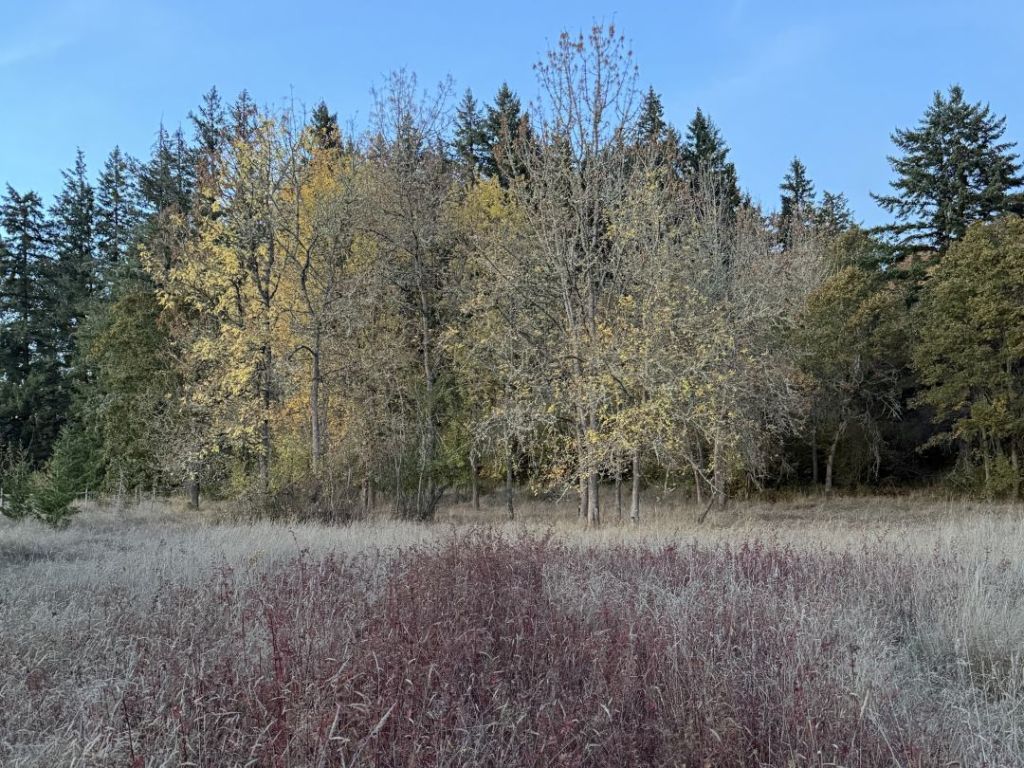
Last month we had the pleasure of accompanying my cousin, Nancy Stueber, on a visit to Edgelands, Greg Shepherd’s new project. Greg is the co-founder at Xera Plants and operator at Edgelands (edgelandsnursery.com). He is creating the five-acre Edgelands project and nursery in Eagle Creek, Oregon, to demonstrate low-impact restoration methods while providing native plant enthusiasts with source-identified plants native to the Willamette Valley. Greg will be evaluating the success of his restoration methods in the Edgelands Blog.
The purpose of Nancy’s visit was to seek Greg’s advice on succession planting for ash trees. All Oregon ash trees are threatened by the emerald ash borer (EAB) which is expected to dramatically decrease the number of trees. One way to deal with the problem is to accept the likely outcome and plan now for the consequences with succession planting to establish diverse, non-ash trees and shrubs now. By doing so, canopy, shade and habitat remain intact as the emerald ash borer spreads across the region.
Nancy has 19 ash trees with a caliper over 6 inches and ten seedling trees less than six feet tall. Greg has 45 mature ash trees with a caliper over 6 and up to 12 inches. Three years into his project, Greg has an amazing variety of native trees and shrubs — a perfect laboratory for his research into restoration.
As Greg explained to Nancy and me, forest succession is the predictable process where tree and plant communities replace one another over time following a disturbance like a fire, storm, or logging. Among other methods, Greg is testing coppicing to preserve some young ash so they can get to blooming age. His hope is that if we can keep this heavy-seeding tree regenerating naturally it can either survive the population spike of the EAB or develop natural resilience genetically. To coppice a tree or shrub, cut all of its stems back close to the ground during the dormant season so the root system sends up a dense cluster of new shoots. This traditional management practice is detailed by the RHS Advice on Coppicing.
Another way to deal with EAB is to establish understory before losing your ash tree(s). If you’re lucky enough to have healthy native plants, then seeing what already works for your climate and soil conditions can guide you. Nancy has noted where other natives are growing on her property — red osier, Scouler willow, red alder, white oak, cascara, beaked hazelnut, snowberry, Douglas spirea, Pacific ninebark, as well as common rush, and slough sedge. She’s using these to identify how wet the soil is. Much of the area grows tall with horsetail and invasive buttercup so she expects there’s subsurface water underneath.
Half of her site is seasonally wet, with standing water much of the winter, then it dries to hard clay in the summer. Based on what she learned from our field trip to Edgeland, she’s going to try planting more willow for canopy to replace the ash. She’ll take live stakes from the Scouler’s willow on site, for the slightly drier areas, and then try Pacific willow and Sitka willow in the wetter areas. In a sunny opening she will try Ponderosa pine sourced from the Willamette Valley (Pinus ponderosa var. benthamian), which can take some wet soil conditions.
Nancy also wants to improve the understory to increase diversity and create shade that will be lost. In upland areas she’s planted ocean spray, mock orange, and vine maple where it’s moist but where they won’t have wet feet. In moderately wet areas where snowberry and Douglas spirea are already established, she’s going to try Pacific crabapple, serviceberry, Douglas hawthorn, Nootka rose, and a twinberry. Black cottonwood would probably do well on the site also. Knowing it’s better to plant multiples of a species rather than one or two of many different species, Nancy plans to experiment to see what takes in these micro environments and then plant more of the same.
Nancy and I were inspired by the diverse environments on Greg’s land, where established native plant communities thrive and other areas are being thoughtfully restored. Greg offered many ideas for growing canopy and understory species that can succeed the ash grove on Nancy’s property and take hold in both wet and upland soils. Nancy especially appreciated his whole-ecosystem approach and seventh generation thinking. As Greg shows, nature has much to teach us if we observe closely.
Many thanks to Nancy and Greg for their help in writing this post!


