Thanks to Trask for the following cautionary story and photo: Recently a neighbor sent us a picture of a Western Screech Owl, a great find! As someone who birds the bluff a couple of times a week, just one picture was enough for me to know where to look. Sure enough the next day I found the screech owl, perched in a cavity.
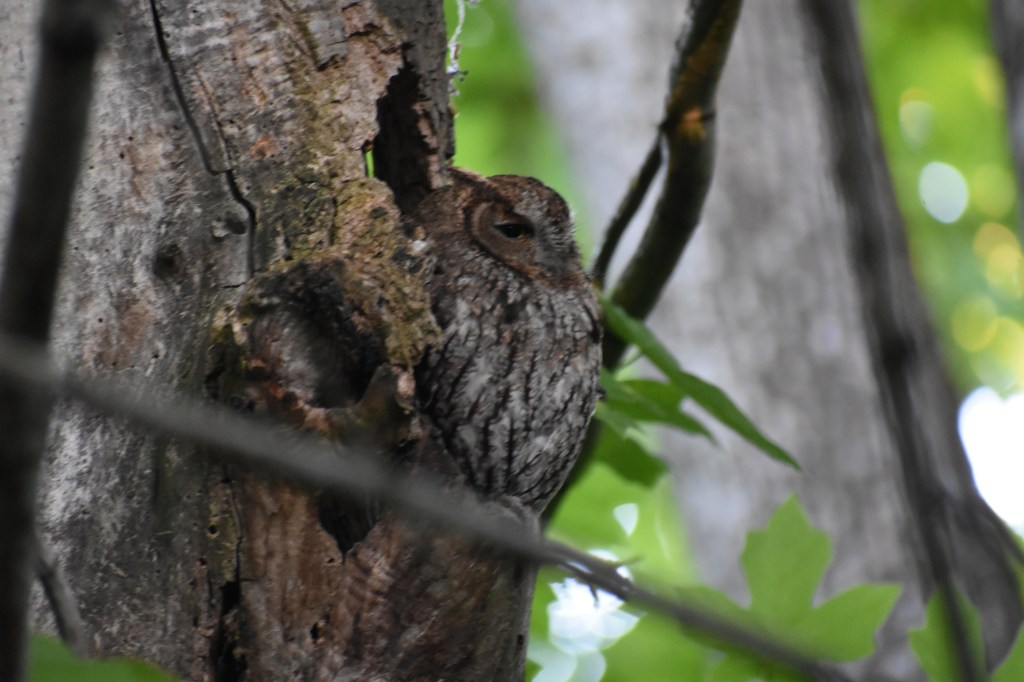
I shared this photo with my friends at the bluff and included the picture on ebird. The next day I received an email from a stranger asking for the location of the owl, so he could take pictures. Here lies the problem with sharing information about owls. No doubt owls are the absolute coolest of the birds we have in the PNW, if not everywhere. Having only seen a handful of Screech Owls (including 3 times at the golf course) I know the allure of seeing these amazing birds! We kept the location of the bird secret, as I had hoped the cavity would contain a nest, and though it ended up not being a nest, keeping it secret was the right thing to do.
Surprisingly Western Screech Owls are likely to be the most common raptor in the city of Portland. They are in most large parks, graveyards, and neighborhoods with many old trees (think Laurelhurst). Nonetheless, as all birds face significant declines, it is important that we approach sharing information about owls carefully.
Here are some important things to consider, from the Chicago Audubon Society, when it comes to owls:
– Don’t get too close – if the owl looks at you frequently, you’re too close.
– Stay on “the sidelines” and don’t enter an open area where an owl is hunting.
– Use binoculars or a scope for viewing and a telephoto lens for photography.
– Use a blind to minimize your presence – your car or even just hide behind a tree.
– Do not intentionally “flush” an owl.
– If you use audio recordings, minimize their impact on birds, and follow the ABA Code of Birding Ethics.
– Use discretion when sharing the location of an owl; usually it’s best to provide details only to people you can trust to treat the owl safely.
– Avoid the use of flash photography, especially after dark.
– Eliminate noise to avoid interfering with a bird’s auditory hunting. If you’re viewing from a car, turn off the engine; if you’re with others, talk in a whisper only when necessary.
The person who shared the original photo with the bluff did absolutely nothing wrong. They found an awesome bird and shared it with people who can be trusted. I followed the rules for dealing with owls and the Audubon’s guide to ethical bird photography: https://www.audubon.org/get-outside/audubons-guide-ethical-bird-photography
I hope our followers and volunteers continue to share their sightings of owls, hawks, and other cool plants/animals seen on the bluff. As the bluff gets more amazing and more people come to visit, it is important for us all to remember to be the best stewards of our environment as we can be.
 Rose City Bluff Restoration