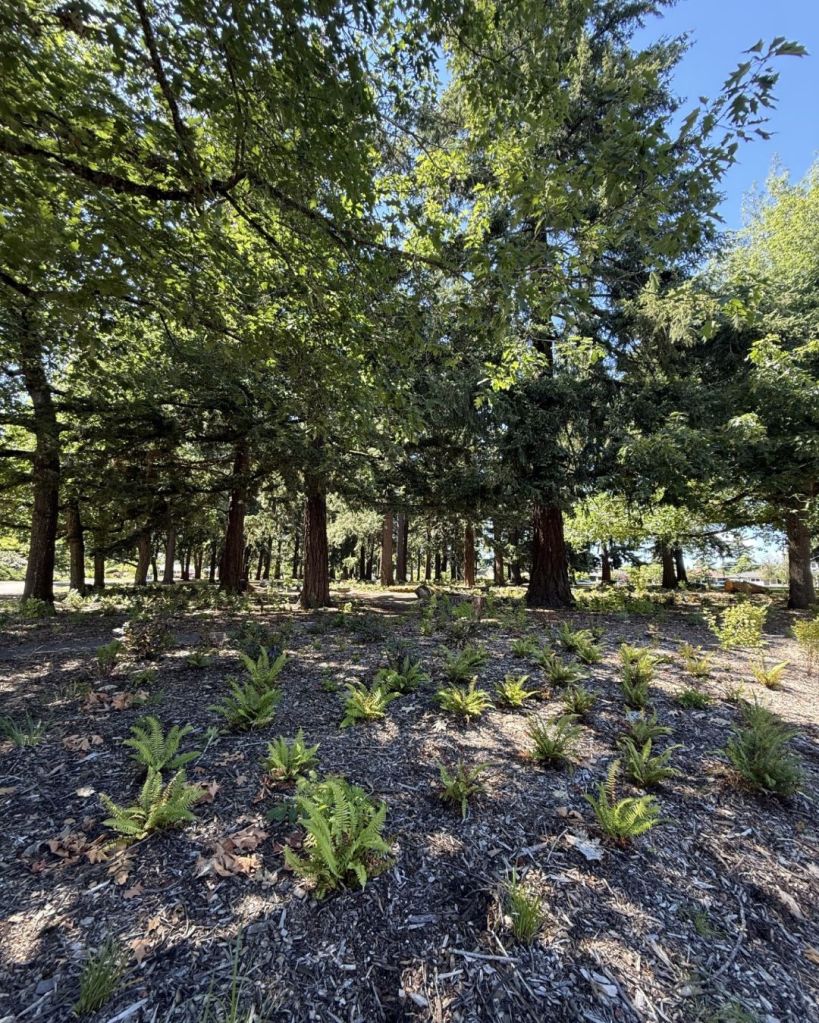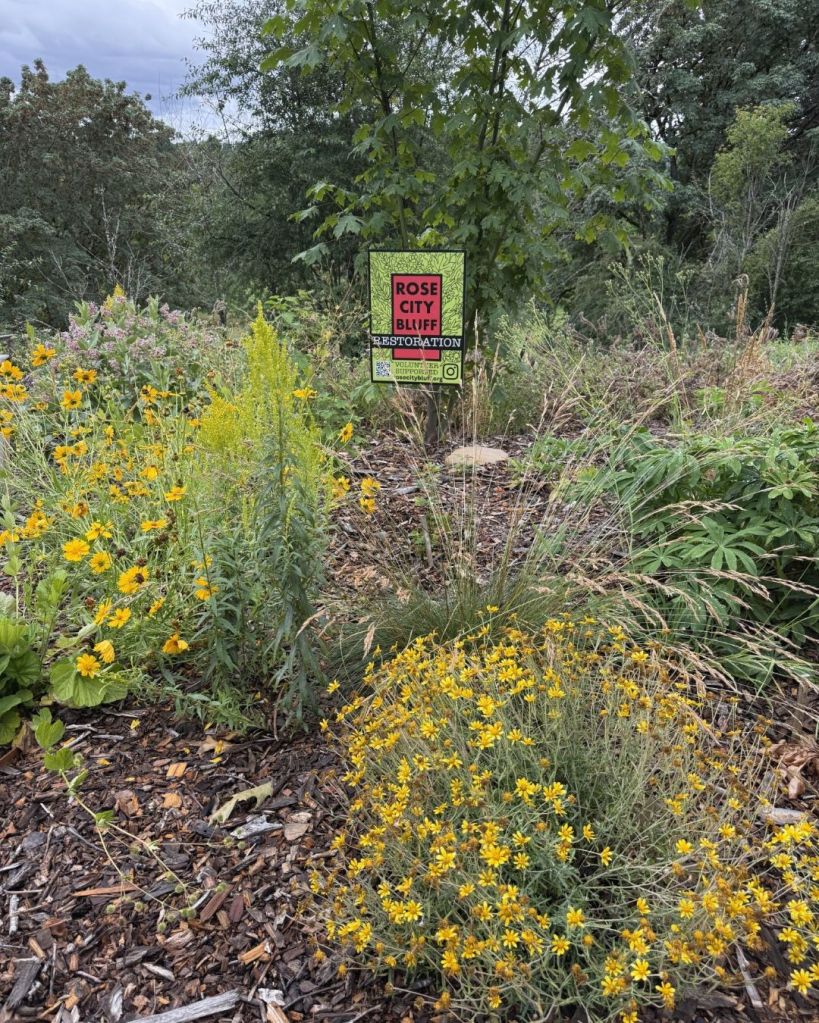
In a recent post we asked whether restoration projects like the Rose City Bluff should adjust plant selection in anticipation of climate change. This is a question for restoration ecology experts who consider policy for much larger restoration projects or even ecoregions. Now, Rose City Bluff Restoration is a relatively small-scale project. But Douglas Tallamy and his concept for a Homegrown National Park are making the case that when we all take part, we create the connected habitats that life depends on.
Seed provenancing in anticipation of climate change is one strategy ecologists consider. Per Wikipedia: “Seed provenancing is a seed-sourcing strategy that focuses on the geographic location of seed sources . . . The traditional approach to provenancing has been to source seed from within the restoration site (local provenancing), but the threats of climate change have sparked debate on whether the use of nonlocal provenances may be beneficial to the longevity of broadscale restoration efforts under specific circumstances.”
Also Wikipedia: “Although it has been long-maintained that the use of local provenance is best since local seed will be best adapted to the conditions, arguments have been made to move away from the strict use of local provenance for populations that are expected to face rapidly changing environmental conditions in the face of climate change. This is because the use of local provenancing can establish a population that does not have sufficient adaptive genetic variation to cope with future environmental changes, thus compromising the longevity of broadscale restoration efforts. Additionally, the strict use of local provenance has the potential to encourage inbreeding and low genetic variation in a population, further threatening a population’s ability to persist long-term. With this, many new provenancing strategies have been proposed to supplement local provenances with nonlocal ones to maximize evolutionary potential to increase the long-term success of restored populations that are facing changing environmental conditions.”
My understanding is that Douglas Tallamy strongly advocates for using locally native plants sourced from your immediate latitude and eco-region rather than wide admixtures, despite climate change. Tallamy warns against the practice of “assisted migration” or sourcing plants from far south of your area to prepare for a warming climate. Because it’s variability that marks climate change, not a gradual benign warming. Local plants are adapted to historical weather patterns and seasonal shifts at that specific latitude. Bringing in non-local ecotypes can result in plants being killed by unseasonal freezes.