“It’s very easy to get quite good at something. I mean if you work hard. And that’s boring. Because it’s the rawness, the directness that you have to be in contact with I think to be able to let a finished piece of work represent the energy that – the awkwardness that went into having such a foolish idea.” (Robert Rauschenberg, 1966)
Though that’s a quotation by an artist about art, it struck us that the sentiment applies to the work that Rose City Bluff Restoration volunteers have been doing since 2018. Rauschenberg’s self-deprecating remark, “having such a foolish idea,” doesn’t really suggest that being clueless is good. He’s addressing the energy that’s missing when we become proficient at producing a predictable result. We believe that also applies to our community of volunteers with the “foolish” idea of restoring five acres of degraded urban land and doing it together even though none of us knew exactly where we were headed. The rawness and directness of the spontaneous volunteer project has generated the energy to both restore the land and create a community of volunteers.
A restoration project relies on volunteers. They come from all backgrounds. They’re not professionals. But the community building dimension of welcoming volunteers and letting each find their own way of contributing is as valuable as the restoration itself. It’s awkward and normally “foolish” to have novices do a big job, but it taps into the energy of a community coming together with a shared, however “foolish,” idea.
A restoration organization can become very skilled at doing restoration in the conventional sense: remove invasive species, prepare the soil, mulch, plant natives, water, weed, repeat. It can become an exercise in executing a known recipe rather than a way for people to become connected to a place and to one another. Rauschenberg’s “that’s boring” could translate into restoration as: “We know how to plant a native plant. The interesting question is what happens when we give an entire community the opportunity to contribute?”
Guerilla restoration necessarily contains awkwardness. A conventional restoration project usually has a defined objective, a plan, permissions, funding, equipment, professional expertise, and a relatively controlled site. Guerilla restoration has none of those things. Someone looks at an abandoned patch of land and has the “foolish” idea: “What if I just started restoring this?” The first attempts may be awkward. You don’t necessarily know which plants will survive, what the existing seed bank contains, how aggressively the blackberry will return, whether removing one species will cause another to explode. You never know how long it’s going to take. You don’t know if anyone is going to come help. But that uncertainty is productive. The awkwardness forces you to pay attention. Everyone gets a chance to prioritize what they think might work.
The restoration equivalent to directness, to rawness, is contact with place. An artist can become separated from the artist’s medium by technique. A restoration worker can become separated from the land by methodology. You can have an expertly written restoration plan and still not really know the site. But when you’re physically pulling blackberry roots, discovering native Oregon grape underneath, seeing all the weeds that emerge after disturbance, and learning to avoid yellow jackets or poison oak, then you are in direct contact with ecological reality.
Rauschenberg says the finished work should somehow reflect the energy and awkwardness that went into making it. Similarly, an ongoing community restoration project doesn’t look like a perfectly installed garden. It retains evidence of an ecological process. The landscape contains the history of the experiment. It isn’t merely a picture of what the restoration volunteers intended. There is an almost philosophical difference between how do we make this landscape look restored and how do we create conditions under which restoration can happen? The second question is much closer to Rauschenberg’s idea. The restoration volunteers aren’t like the artist who methodically creates a perfect landscape. Instead, they are participating in an encounter between the land and ecological processes.
A beginner may look at a patch of degraded land and think, there are five acres of blackberry thickets here. What if we started by clearing around the good plants? An expert might immediately say that isn’t how you normally undertake a five-acre restoration. But the beginner’s apparently “foolish” idea can produce information the conventional approach wouldn’t. A small volunteer group working on a difficult, degraded, steep site doesn’t have to compete with the technical efficiency of a professional ecological restoration contractor. Its potential advantage is the opposite: curiosity, persistence, intimacy with the site, willingness to experiment, and the freedom to discover something nobody expected. The awkwardness isn’t a deficiency. It’s the source of its creativity.
The professional model optimizes for competence – get the right people, give them the right tools, train them, and accomplish the task efficiently. The volunteer restoration model has a different objective. It seeks a way for people to become connected to a place and to one another. That changes the definition of success. The inefficiency is partly the point. A professional crew can remove many more blackberry in a day than a work party of inexperienced volunteers is able to remove. The professionals win, but the volunteers may have learned to recognize Oregon grape; learned why blackberry is difficult to remove; discovered something about the site’s history; met neighbors they didn’t know; developed a relationship with the place; gained confidence doing something they had never done; and, started thinking of themselves as someone who can restore habitat.
So, there are two results, one ecological and the other social. And this makes “foolishness” surprisingly valuable. If everything must be done correctly by experts, most people become spectators. If the project says, come help us figure this out, they become participants. And participation creates ownership. That’s particularly powerful in an urban restoration project because you’re not simply restoring an ecosystem. You’re potentially creating a community of people who feel responsible for that ecosystem.
An awkward participatory restoration project can be democratic. The experienced person knows about identifying plants. The student knows about engaging potential supporters on Instagram. The neighbor knows what the land was like many years ago. A volunteer has extraordinary persistence pulling blackberry roots. The project becomes a place where knowledge is acquired by interacting with other volunteers, rather than a prerequisite for participating.
The awkwardness of the novice isn’t merely something to tolerate until they become competent. It is part of what they contribute. They see things differently precisely because they don’t yet know what they’re supposed to see. There’s a paradox here. A restoration project can be less efficient at restoring land but more efficient at restoring community. And eventually those two things reinforce one another. Volunteers who work on the Bluff begin to recognize it as their place. They notice when something blooms. They notice when blackberry comes back. They bring someone else. They care about what happens there. At that point, we’ve created something more durable than a completed restoration project. We’ve created stewards.
The awkwardness of restoration isn’t merely the awkwardness of experimentation. It is also the awkwardness of participation. Professional restoration seeks to minimize awkwardness. Community restoration can use awkwardness as a way of letting people in. A restoration project shouldn’t only restore habitat. It should restore people’s relationship with the possibility that they can change the place where they live. Awkwardness isn’t necessarily the opposite of excellence; sometimes it’s the condition that allows participation, experimentation, and community to happen.
Rose City Bluff Restoration wishes to acknowledge John Nikkel for having a “foolish” idea.
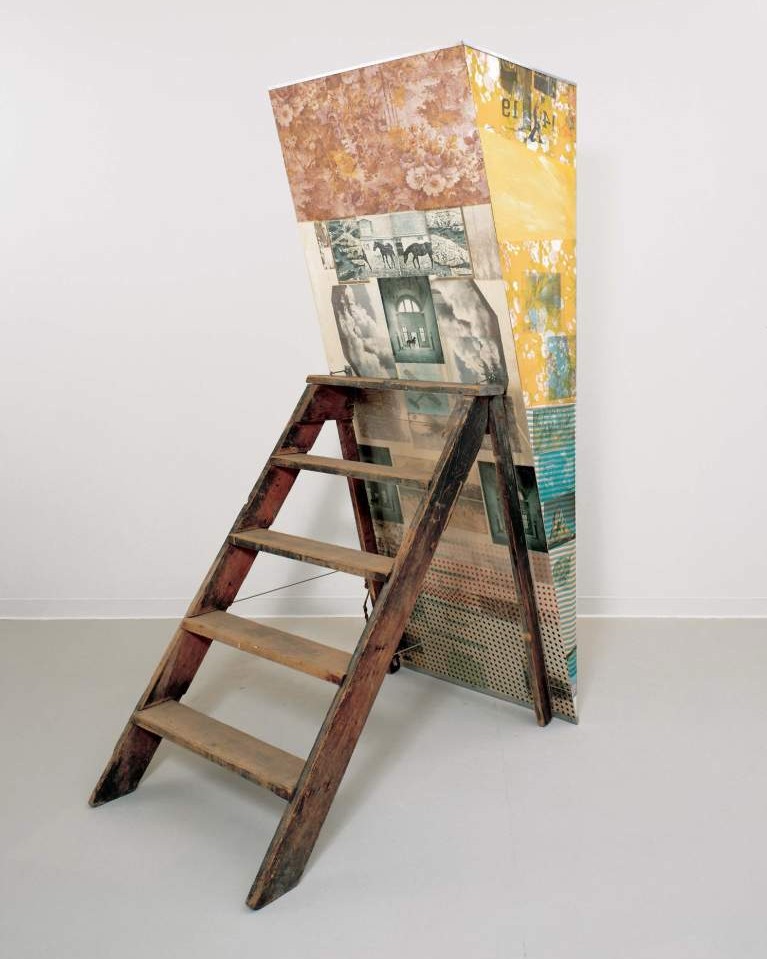
Permanent Collection of the Portland Art Museum
The Rauschenberg quote is from the U.S.A. Artists series broadcast by National Educational Television (NET), 1966.


