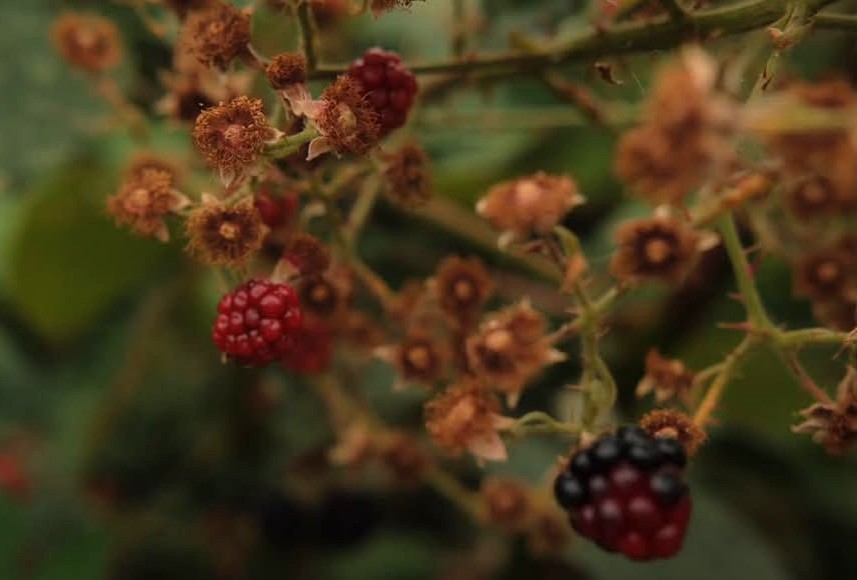
We came across a story about how researchers at Idaho Fish and Game used genetic biocontrol to eliminate an invasive trout from two Idaho streams. To do so, they released “supermale” versions of the invasive brook trout into the streams, which doomed the population. Sometimes called trojan YY males, the supermale breed of the invasive fish has two Y chromosomes instead of one. The offspring of supermales are all male, eventually producing a population that consists only of elderly bachelors. We wondered if there could be something comparable done to eliminate Himalayan blackberry (Rubus armeniacus). The short answer is almost certainly not, but we were curious about why not.
The general term for using genetic techniques to manage or suppress invasive populations is genetic biocontrol. (Note: We are in no way advocating for or against genetic biocontrol.) Researchers have investigated genetic biocontrol of invasive plants including the plant equivalent of a trojan Y strategy, but plants don’t have the same sex-chromosome machinery that makes the fish approach so elegant. One potential plant strategy, making the population progressively less fertile, is using a genetic element found in plants called cytoplasmic male sterility (CMS) which causes plants to produce sterile male reproductive structures. Researchers at the University of British Columbia have studied using the naturally occurring phenomenon of CMS to eliminate invasive plant populations. The introduction of CMS alleles (a specific variation of a gene located at a specific position on a chromosome) into a population of invasive plants represents an effective control method for only a select number of species of plants, not including Himalayan blackberry.
A closer analogy for plants to the supermale brook trout strategy would be gene drive. A gene drive is a genetic system that causes a particular genetic variant to be inherited more often than the normal 50% expected under Mendelian inheritance. If the favored gene also reduces fertility or survival, it can potentially spread through a population while simultaneously destroying that population’s ability to reproduce. A 2019 paper, “Gene drives in plants: opportunities and challenges for weed control and engineered resilience,” examined exactly this possibility. It concluded that gene drives offer one potential solution to invasive plants. However, key questions remain, including the efficacy of engineered drives, the potential for resistance evolution, and how plant genetics may influence their spread and impact. Himalayan blackberry reproduces primarily through a process called apomixis. Around 90% of Himalayan blackberry seeds develop asexually via apomixis, meaning the resulting seedlings are genetic clones of the parent plant. Himalayan blackberry’s reliance on asexual apomixis blocks the sexual inheritance required for a gene drive to spread effectively.
Plants are harder targets than fish for population level genetic manipulation. Most plants are not dioecious (having male and female reproductive organs on separate individual plants). That makes simply eliminating one sex of the species impossible. Himalayan blackberry is monoecious (producing flowers that contain both male stamens and female pistils in a single blossom). Individual plants are completely self-fertile and capable of producing fruit entirely on their own. Pacific blackberry (Rubus ursinus), which is the native blackberry species, is uniquely dioecious.
Himalayan blackberry can reproduce through vegetative reproduction or vegetative cloning (i.e., root tipping). The root crowns or woody base of the plant continually produce new canes and readily re-sprout after a disturbance. Horizontal underground shoots expand thickets and send up new growth. Root fragments left in the soil can successfully grow into entirely new plants. That is a nightmare for a genetic control strategy. Even if you engineered a clever reproductive genetic system, killing seed production wouldn’t necessarily kill the population because the plant can reproduce vegetatively.
There is another complication. Himalayan blackberry’s persistent seed bank would remain even if you successfully suppressed reproduction. This is one of the central problems in plant gene drive research. A 2026 Nature Plants study found that dormant seeds can continually reintroduce non-drive individuals into the population and substantially slow the spread of a gene drive. Himalayan blackberry has precisely the sort of persistent seed bank that makes this important.
So, count us as disappointed that a gene drive of supermale Himalayan blackberry can’t come to our rescue.
Postscript: Pacific Northwest native trailing blackberries (Rubus ursinus) can naturally hybridize with the invasive Himalayan blackberry (Rubus armeniacus), though it happens infrequently. Himalayan blackberry also hybridizes with cutleaf blackberry (Rubus laciniatus) and some other introduced blackberries. The USDA Forest Service reports hybrid swarms in parts of the Pacific Northwest and California.